Pictures and highlights of my visit to Devon on Friday 11 and Saturday 12 October.
My first attendance at the annual forum of the Walled Kitchen Garden Network 1 was a fruitful and enjoyable experience. To tell this story, I have decided to draw on fresh memories, trusting my senses to figure out what counted most. A change from my normal process of researching before writing. Gardening is about life, rather than just horticultural knowledge and practice or estate management, isn’t it? I have chosen some key photos to take you on my journey of discovery.
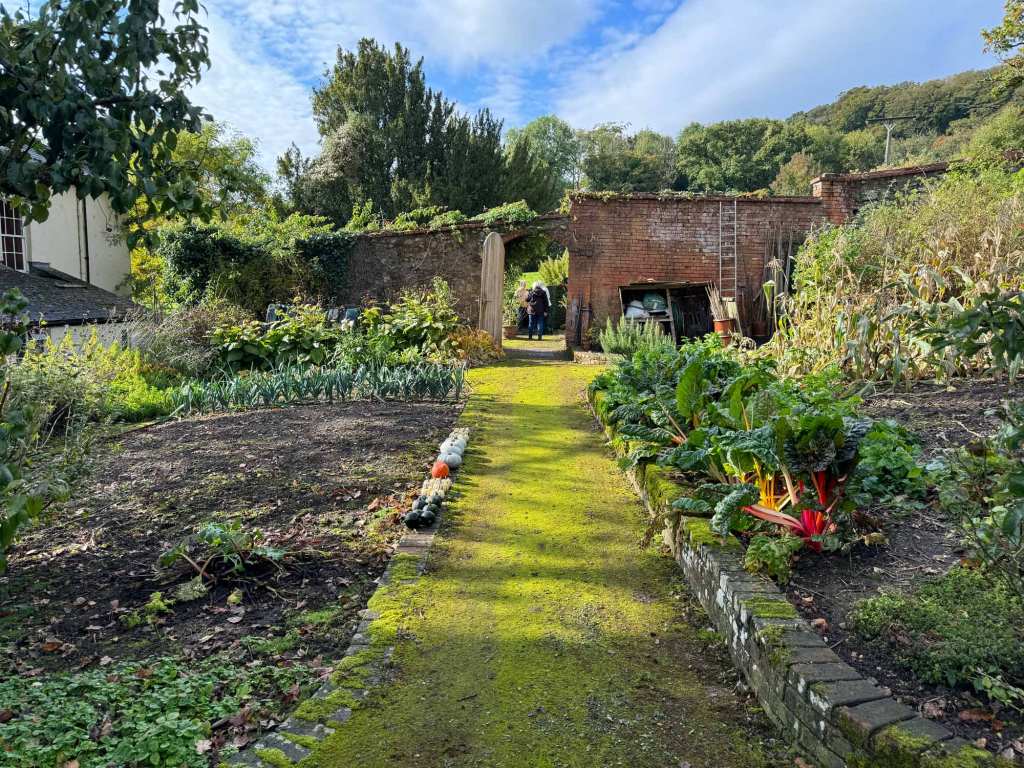
One of the four wonderful gardens we visited. Photo 12 October 2024, Regency House, Devon, UK.The Forum started with a series of talks. The first one, ‘The Glasshouse and Walled Kitchen Garden at Althorp’ (Wales), was given by archaeologist Dr. Siân Thomas. Photo 11 October 2024, TivertonWhat fascinated me was her description of the various parts of the Glasshouse’s ruins built over the centuries, and how precisely their functions were identified. I learnt later that the Walled Kitchen Gardens Network had helped achieve this by connecting her to glasshouses experts. They found the remains of a vinery, a hot wall probably aimed at producing fruit like peaches, various pineapple pits, still used in the 1870s, and of course the watering and heating systems required to grow this kind of fruit at such latitudesDuring his ‘The Walled Garden at Wood’ speech, Lord (Julian) Darling explained how they redesigned their walled garden, taking down the kitchen garden to a more manageable size (above the oblique alley). He also mentioned that all the British 1000-5000 acres estates he knows of have a walled kitchen garden. What a rich heritage! He explained how the Heritage Property tax relief scheme can help protect such valuable assetsMichel Schlosser of the Amis du Potager du Roi, Versailles, France, updated us on the Art of Espalier project 2. The art of training fruit trees to shape them and optimise fructification was listed as Intangible Cultural Heritage by the French Department of Culture in 2023 3. The project is now aimed at reaching international recognition by UNESCO 4. As part of the initiatives taken to that end, Michel mentioned the creation of a European centre for fruit tree trainers education. He also invited the audience to the “first world days of the Art of Espalier” which will take place online on 1-2 March and 20-21 September 2025Before taking us to The National Trust’s Knightshayes walled kitchen garden 5, its head gardener Will Woodman and his team presented ‘The History and Future of the Kitchen Garden at Knightshayes’. Part of the talk focused on practical guidance for organic gardening. The Encyclopedia of Organic Gardening was cited as a useful, easy to find and affordable reference. I took this photo of the book in the walled garden polytunnel where we had lunch. I have since bought the 352 pages 2005 paperback edition online for £3.57 including delivery. Yes, £3.57!In Knightshayes’ walled kitchen garden, where the gardeners’ team guided us and answered our questions. We can see the espaliered fruit trees against the 19th century wall.On Saturday, we visited three privately owned gardens. Regency House’s 6 was much smaller than Knightshayes but beautiful. The owners welcomed us in the warmest way, as did everyone during this most cheerful weekendInside the walled garden at Regency House. We were lucky with the weatherThe garden is very productiveI focused on the apple trees. Owner Jenny Parsons and I agreed that they were quite vigorous for trees grafted on M106 rootstockMost of the fruit had already been harvested and stored in a cool and airy dark place for conservation I was quite impressed by this record of what grows where. Ten apple trees of ten cultivars, eaters to the left side of the ‘central avenue’ and cookers to the right. Jenny Parsons also told me that the cultivars were ordered by ripening timeThe ‘central avenue’. The trees have been trained as contre-espaliersA picture of a ‘George Cave’ windfall (eater). What surrounds it suggests how rich the soil and the ecosystem are in this gardenI feel like showing more of the produce. Here is a close-up of a 8cm cooking appleSwiss shard I supposecucurbitaceaeWe liked the palette of greens, from the yellowish path to the blueish brussels sproutsAre these artichokes below the fig tree, or cardons? I love the organised wilderness and unchecked luxuriance of British gardensallied with tidy ornamental arrangementsThe large trees next to the walled gardenThe small Greenhouse leaning against the wall on the outsideAnd the fields around, which I believe provide mulch for soil protection and fertilisation of the plant beds in the walled garden. This has been my favourite visit of the day, because the garden is mature, very much alive and of a manageable size as a family kitchen garden.The second and third visits were great too. Entering Ashley Court’s garden 7What struck me is that the walled kitchen garden was not featured as an asset of the property when it was advertised to the current owners who bought the estate eight years ago. They found it when they “pushed a door” in a wall “fully covered in ivy”. I think its tells a lot about what needs to be done to revive interest in walled kitchen gardens heritage and local food productionThis contre-espalier, one of the “very old pear trees still producing blossom and fruit”, is evidence of how the garden combines the old and the new, the new being embodied by its current owners who are reviving the placeThe garden is like a small valley where cold air may accumulate at the bottomHence the presence of a “frost window”, here seen from the outside, enabling cold air to move away from the garden when opened. It must help to avoid for instance damage to the fruit trees’ blossom in spring Another distinctive feature at Ashley Court, less anecdotal than the frost window, is the big fruit storage space. Something worth reviving I would say.The walled garden at Holcombe Court 8, our third visit, is a huge spaceIt comprises a pristine kitchen garden with ornamental features, including fruit trees (here an apple contre-espalier),vegetables,as well as an impressive set of twenty years old fruit espaliers growing against the West, South and East facing walls A traditional orchard grows beyond the walls. We can see the top of a tree to the left behind the fig treeThe first page of the photographic record of the renovation that began twenty two years ago. The owner detailed its various stages, making this visit another very instructive experience.
Highlights
The talks and four garden visits were varied and all instructive in their own ways. We felt it was a privilege to have access to such an amount of expert knowledge and best practice, to visit such wonderful places, and to be so warmly welcomed everywhere.
To me the highlights of the Forum came from the conversations generated among the attendees and their hosts, during but also outside the events. I will remember our Friday dinner at a local restaurant where we discussed fruit use after tasting three varieties of apples brought to the table by one of us. We exchanged views, laughed a lot, drafted plans for the future. The conversation continued the day after, for instance during breakfast at the guest house where five of us were hosted.
I suppose each of us left the forum with something different. To me, it was the confirmation that in kitchen gardening, carried out in a listed property in the countryside or in a community garden in a deprived urban area, food matters. It may be obvious, but I think we need to say it and say it again: the future of kitchen gardening is in the consumption of the produce as much as it is in the gardening itself?
One of the places where we enjoyed the experience of being together and chatting. We had the most beautiful food prepared by the owners with the produce of their garden. I sat next to Jim Buckland, former head gardener at West Dean who created and ran its exemplary gardens with Sarah Wain for twenty eight years 9. We talked about the art of gardening, his photographs from the early years, how long it took for them to feel satisfied with their creation, The Edward James Foundation 10. To my right was Jenny Parsons, Regency House’s owner. We acknowledged what a wonderful moment this was.
A big thank you to the organisers of this impeccably planned and run event. The clock on the picture above is evidence of it: we had risen from the table a minute beforehand, as we were to head off at 2pm to our next visit. I hope I will be able to join again next year in Scotland where the 2025 Forum should take place.
Most civilised indeed. It was also quite interesting to see how one of the owners is pursuing the work her predecessor started in the 1950s, evidencing local life in the village next to her estate through photos and videos.
So encouraging and inspiring! I feel very blessed to get this peek at the gardens you were able to walk through — Probably if I had been able to visit in person my heart would be flip-flopping with excitement. Thank you for sharing!!
What a terrific photo-journey and insight into those walled kitchen gardens! I especially loved reading about how the walls, espaliered fruit trees and the layout all contribute to both productivity and heritage. If anyone here is thinking about planning or redesigning their own small garden space, I found this tool Grow a Garden Calculator really helpful for visualising spacing, bed sizes and planting schedules. It made me view my own garden a little more like the structured yet dynamic spaces you describe. Thanks for sharing your visit and the detailed reflections very inspiring!
Thank you very much for your comments and link Dany! I am glad you liked the article and I look forward to discovering the Garden Calculator. We are in Switzerland today, attending the international fruit and arboriculture exhibition Europom 2025. For your information, the 2026 event, organised by the Royal Horticultural Society, will take place in Devon, not far from the gardens described here. A must attend event for aspiring and more confirmed arboriculturists as well as amateur gardeners interested in the diversity of our fruit heritage and how we can benefit from it in our gardens.


 Les Jardins d'ici
Civilised gardening
Most civilised indeed. It was also quite interesting to see how one of the owners is pursuing the work her predecessor started in the 1950s, evidencing local life in the village next to her estate through photos and videos.
So encouraging and inspiring! I feel very blessed to get this peek at the gardens you were able to walk through — Probably if I had been able to visit in person my heart would be flip-flopping with excitement. Thank you for sharing!!
Thank you Joanna! Sorry I missed your comment last year. Please see my reply to Dany today and hopefully see you next year in Devon at Europom 2026!
What a terrific photo-journey and insight into those walled kitchen gardens! I especially loved reading about how the walls, espaliered fruit trees and the layout all contribute to both productivity and heritage. If anyone here is thinking about planning or redesigning their own small garden space, I found this tool Grow a Garden Calculator really helpful for visualising spacing, bed sizes and planting schedules. It made me view my own garden a little more like the structured yet dynamic spaces you describe. Thanks for sharing your visit and the detailed reflections very inspiring!
Thank you very much for your comments and link Dany! I am glad you liked the article and I look forward to discovering the Garden Calculator. We are in Switzerland today, attending the international fruit and arboriculture exhibition Europom 2025. For your information, the 2026 event, organised by the Royal Horticultural Society, will take place in Devon, not far from the gardens described here. A must attend event for aspiring and more confirmed arboriculturists as well as amateur gardeners interested in the diversity of our fruit heritage and how we can benefit from it in our gardens.