
| We met in Belgium, the country of pears, for our annual celebration of fruit biodiversity, while COP 16 was being held in Columbia. |
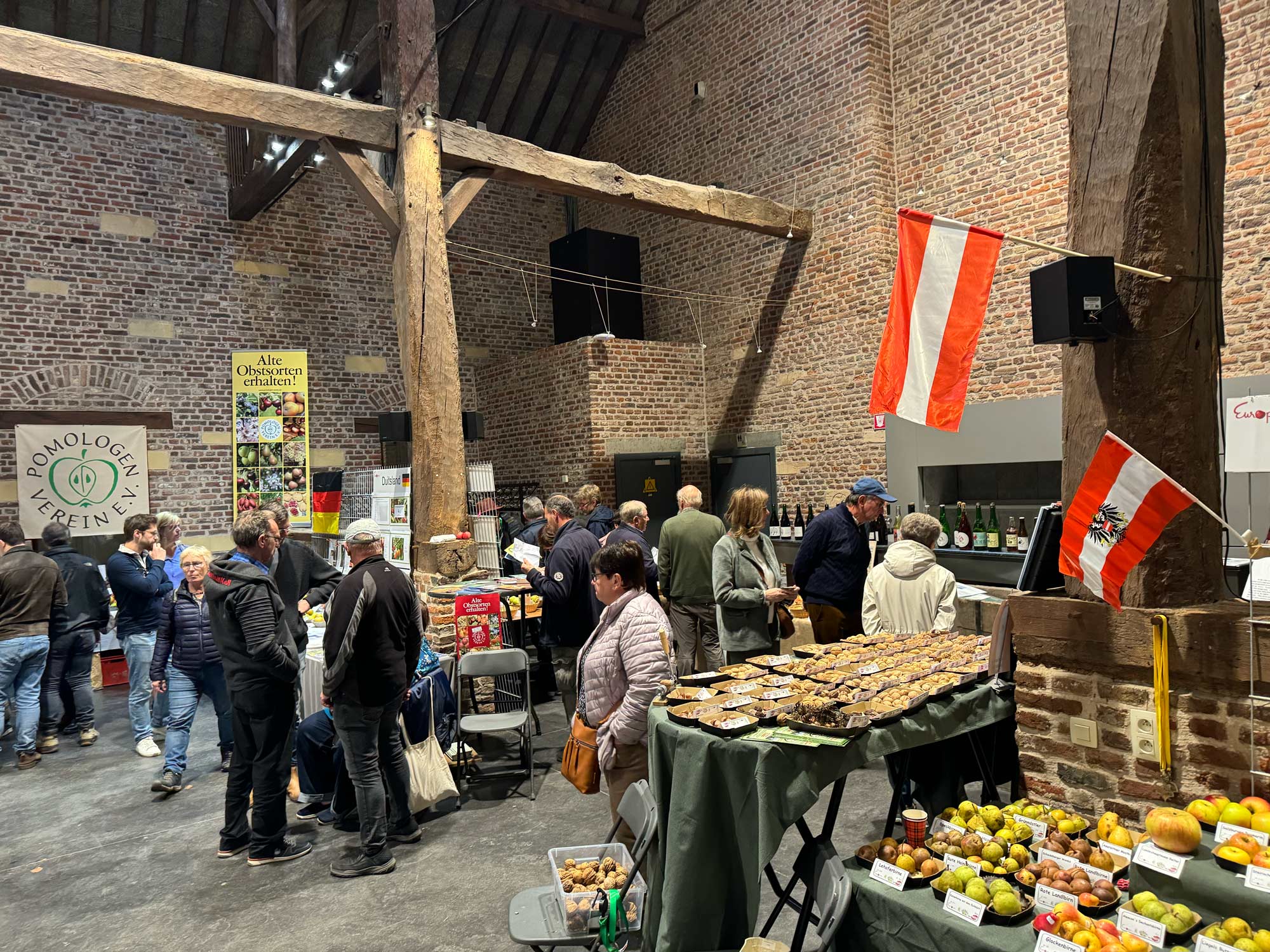
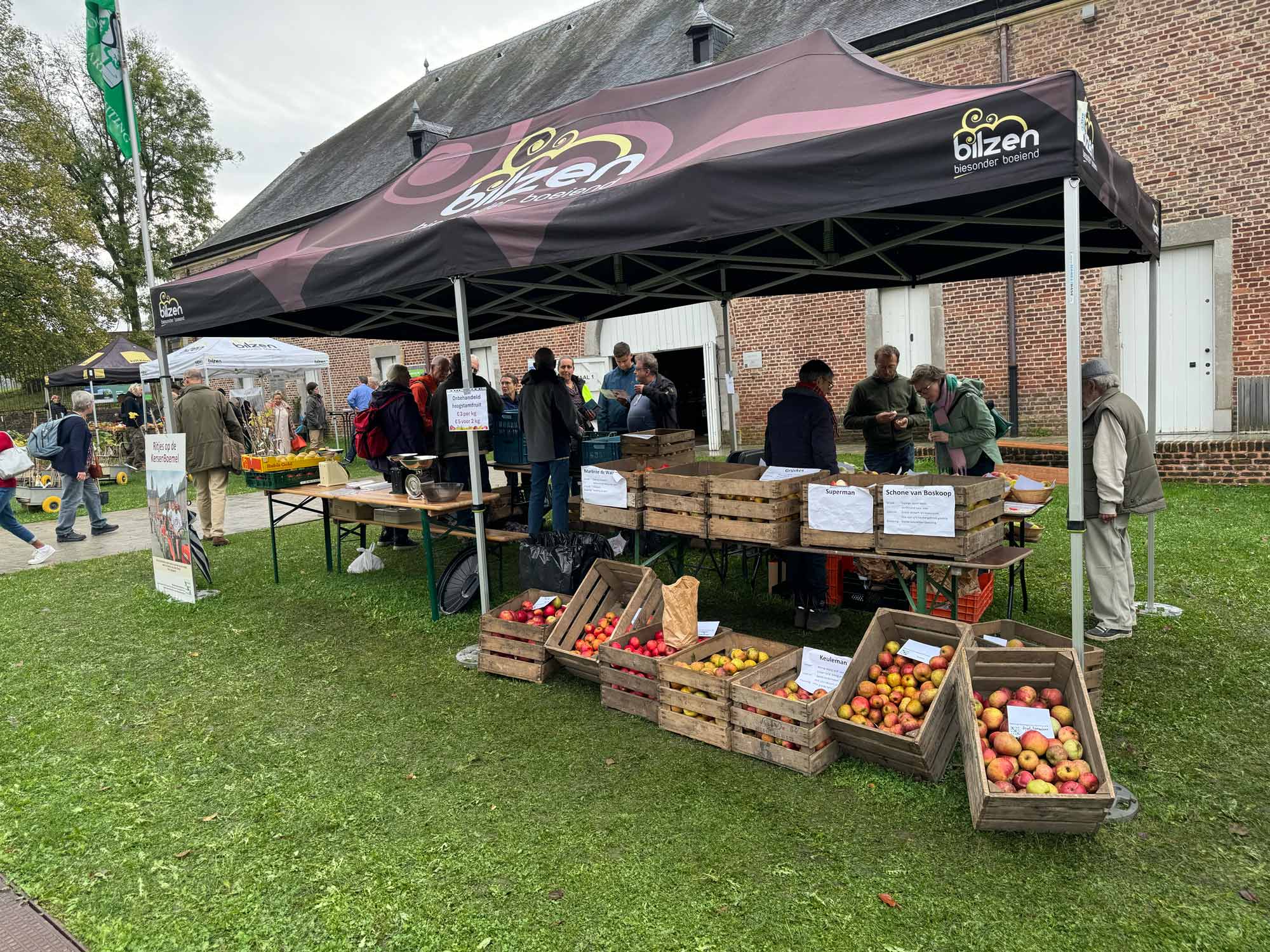
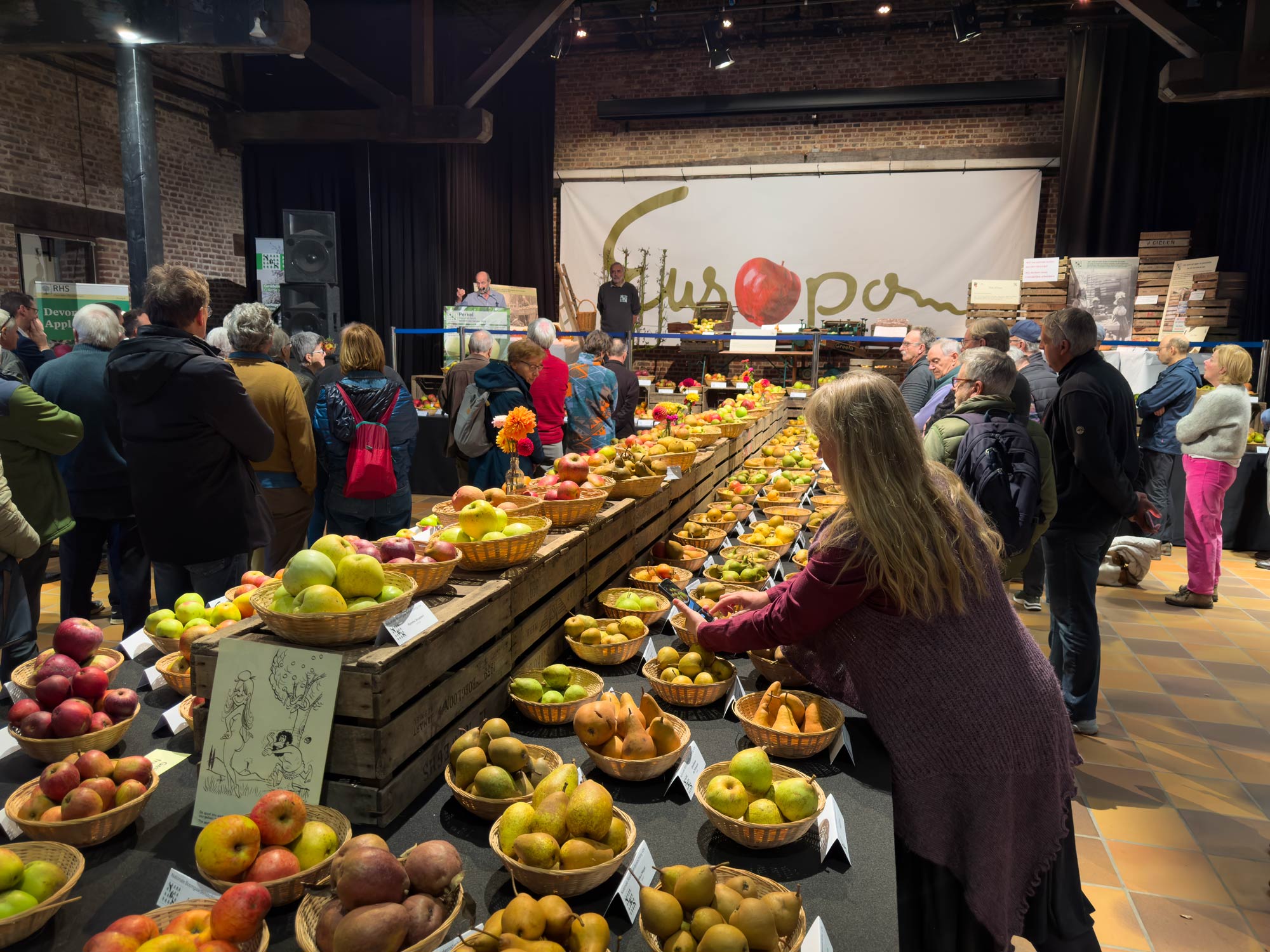
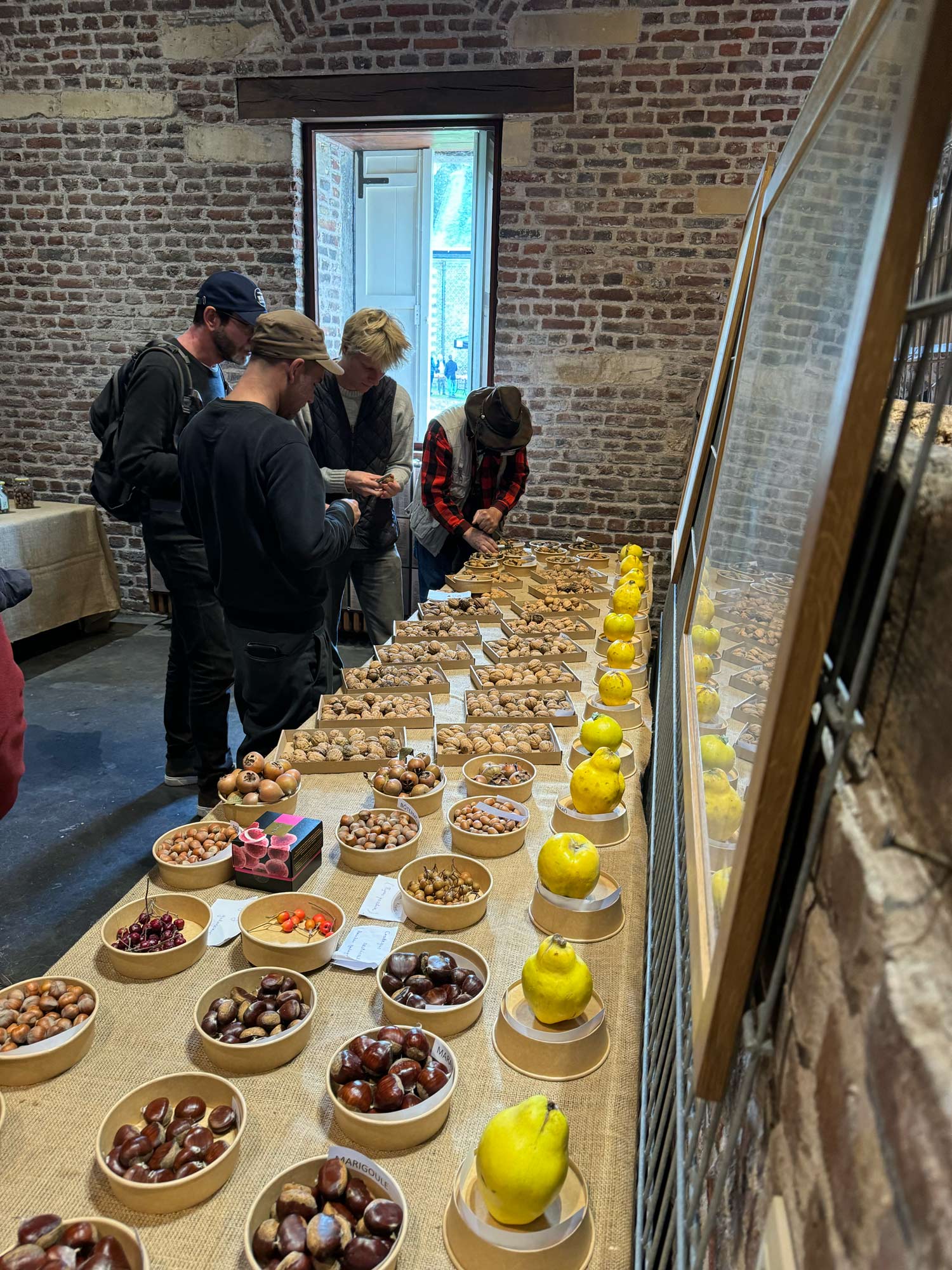
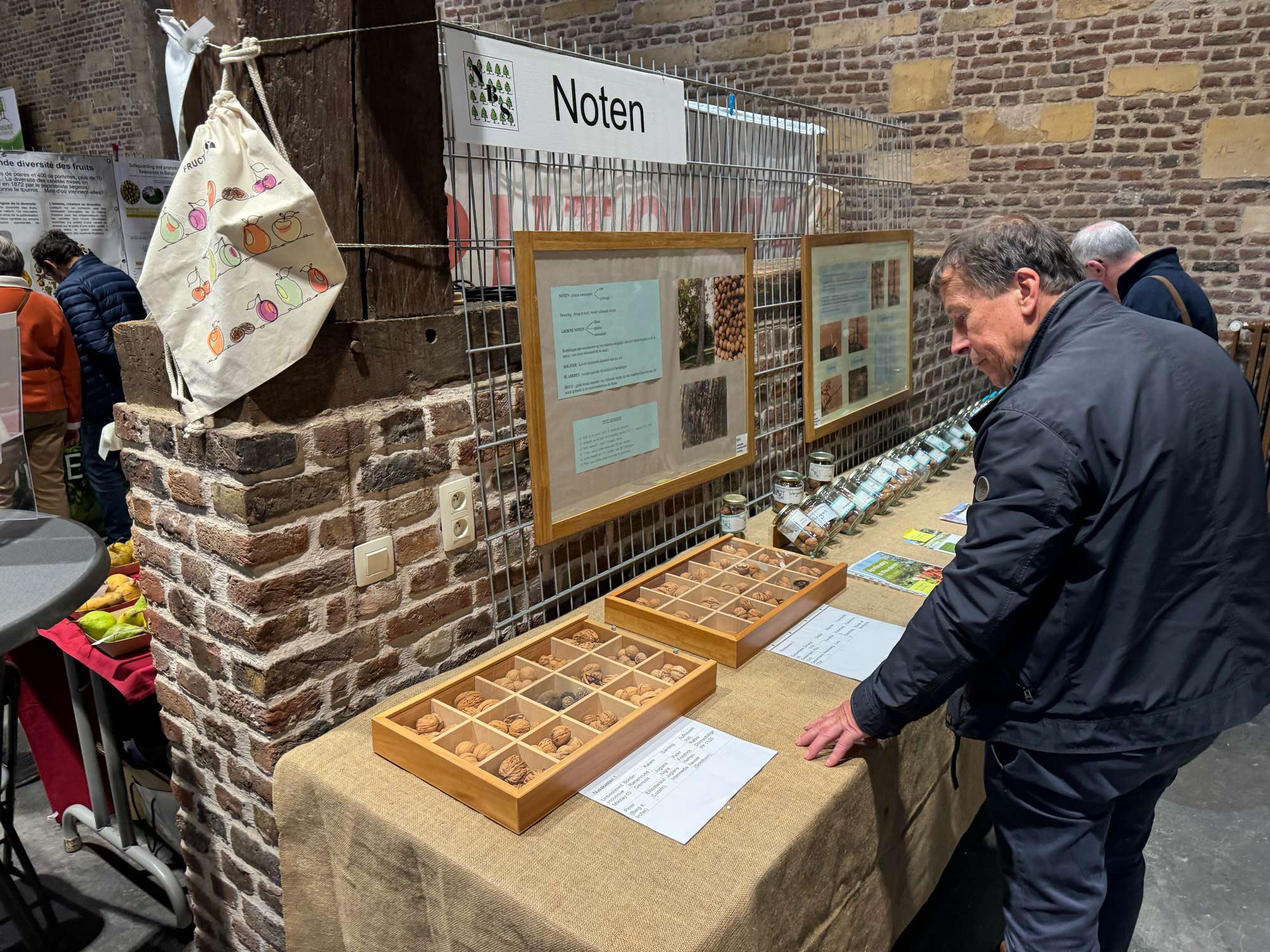
On 26 and 27 October 2024, non-profit organisations from ten European countries aimed at safeguarding heritage fruit varieties gathered at Alden Biesen castle in Belgium to attend Europom 2024. They showed hundreds of varieties of seasonal fruit to the public: apples, pears, quinces, medlars, chesnuts, walnuts and hazelnuts. This article reports on the event, before briefly questioning the COP Biodiversity conclusions.
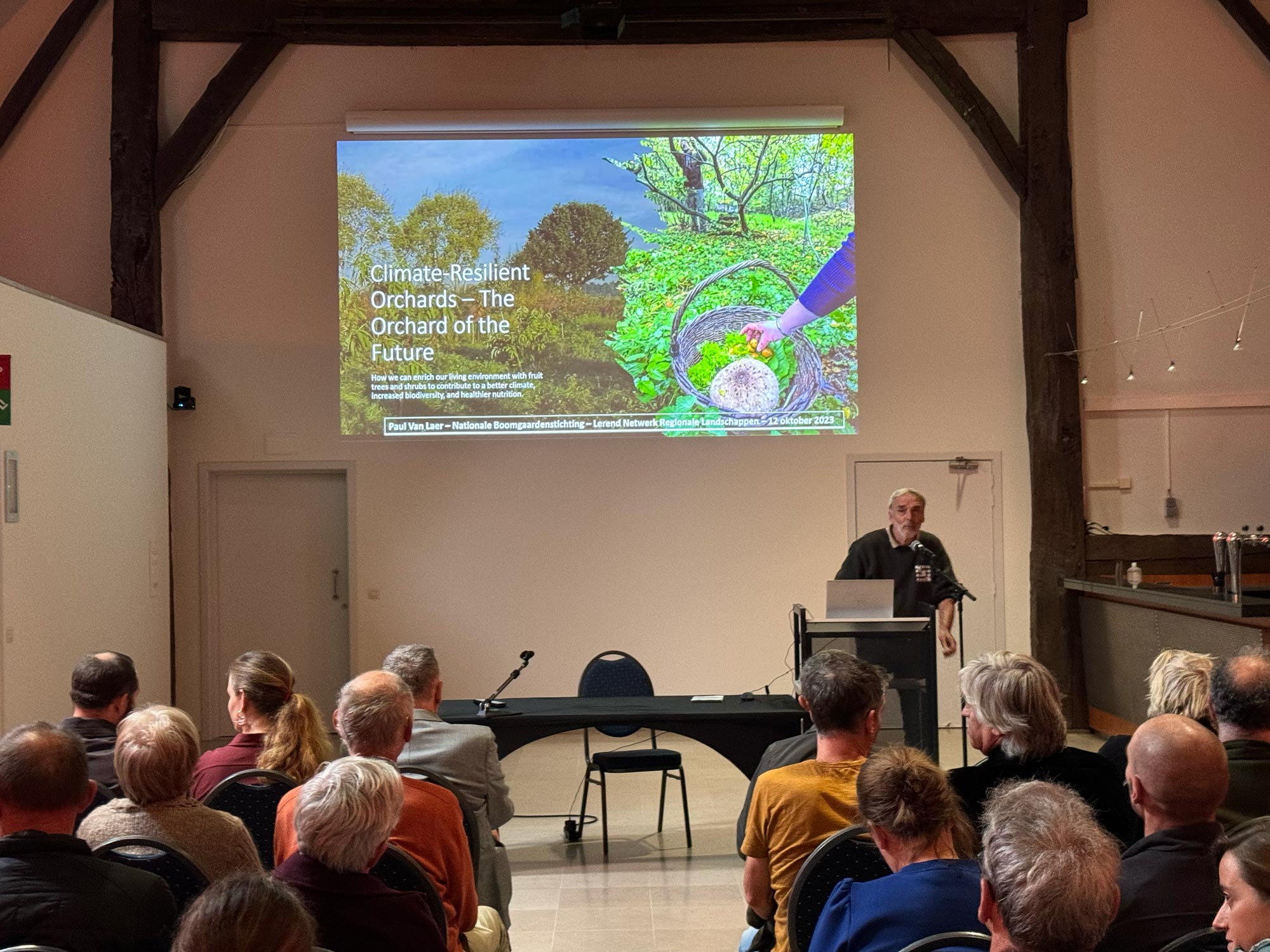
The exhibition
The surroundings
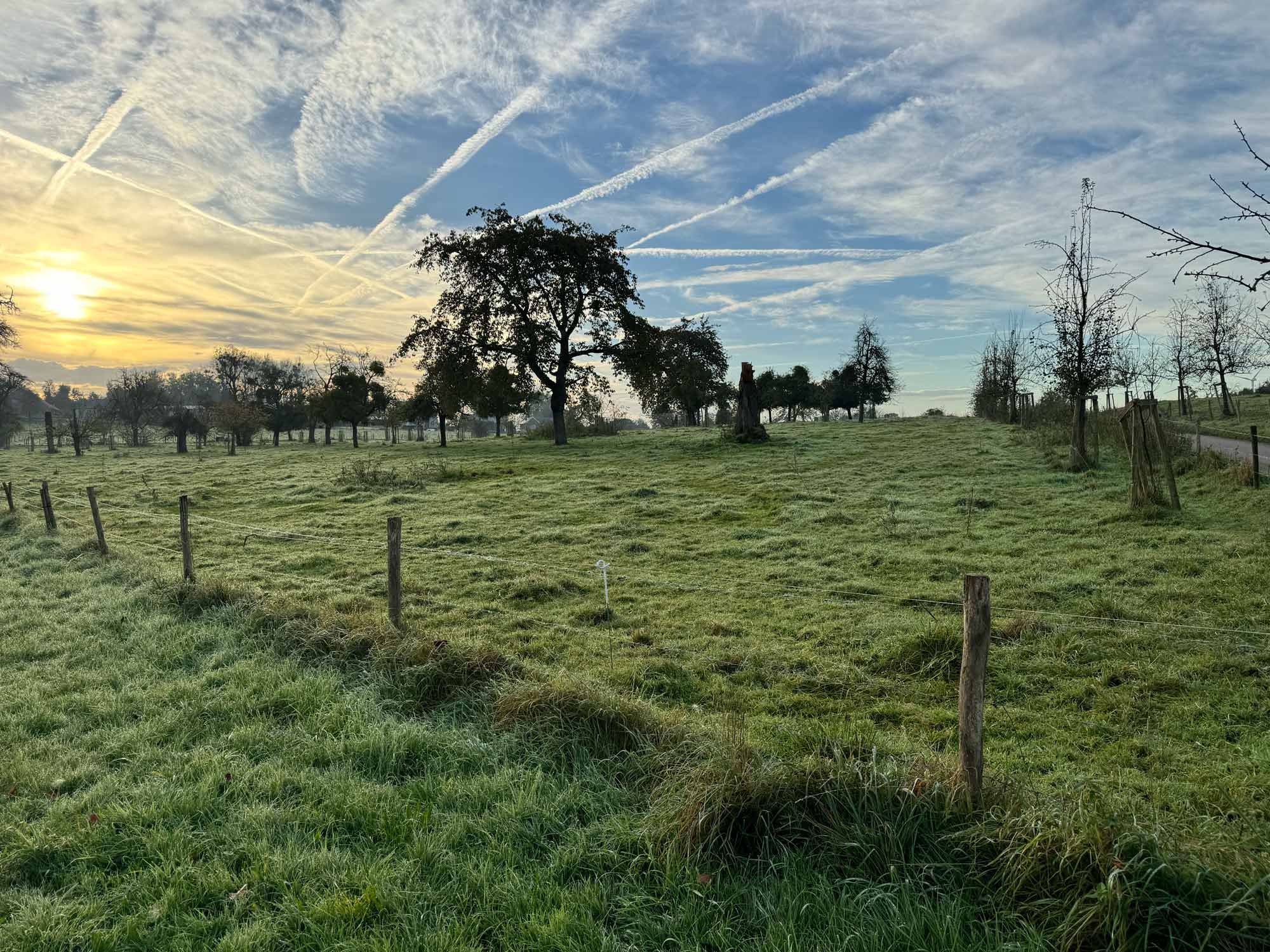
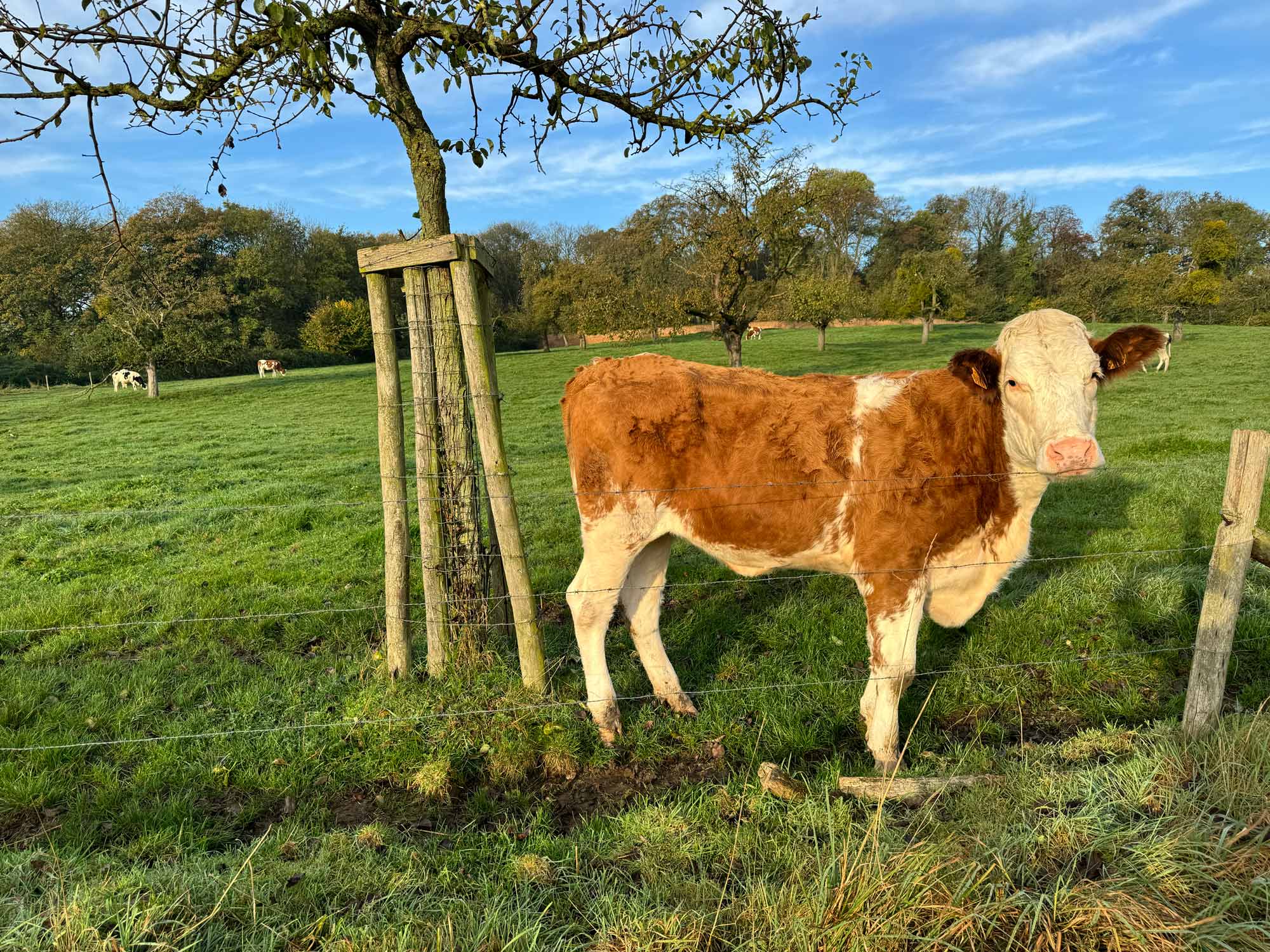
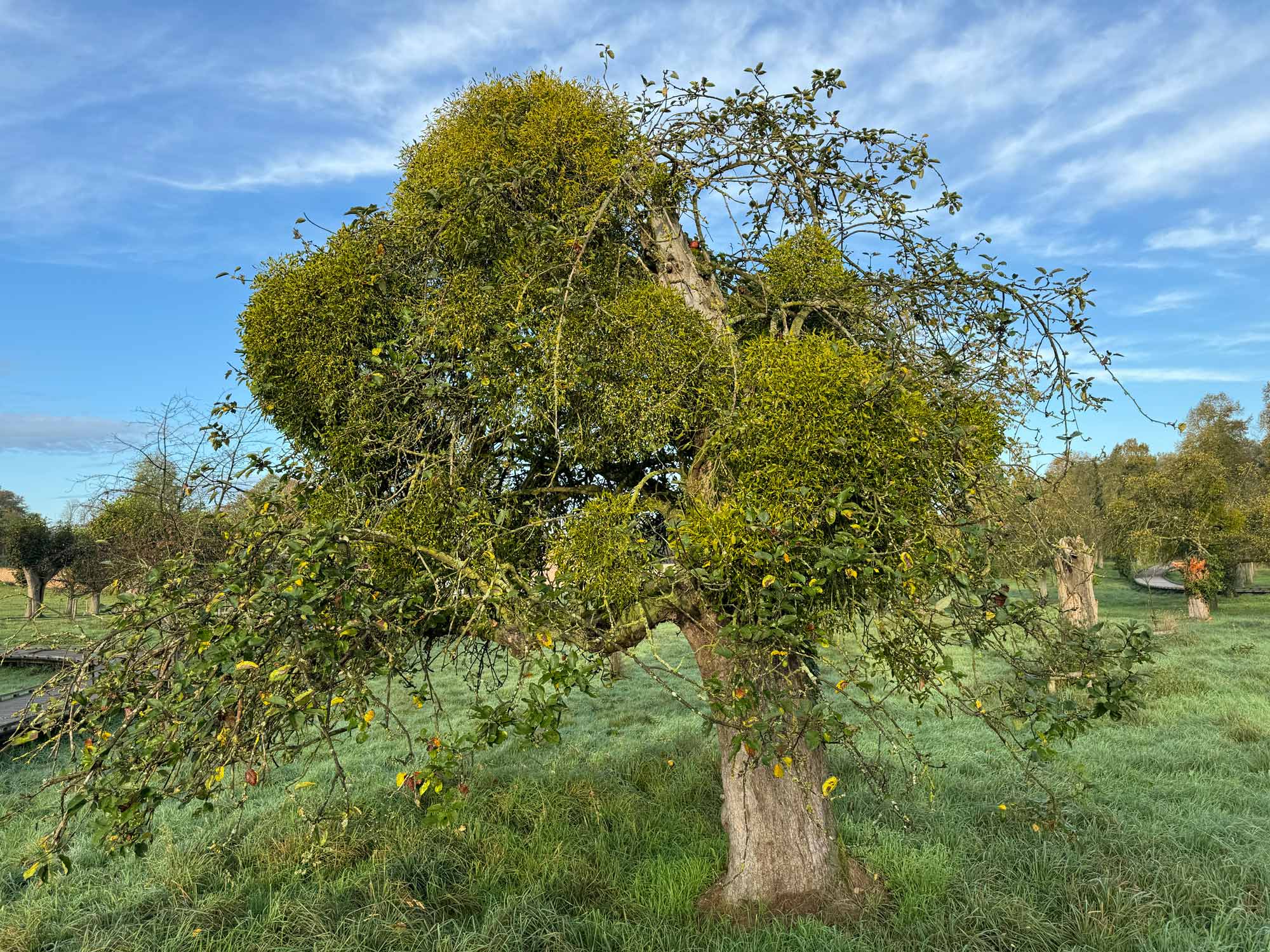
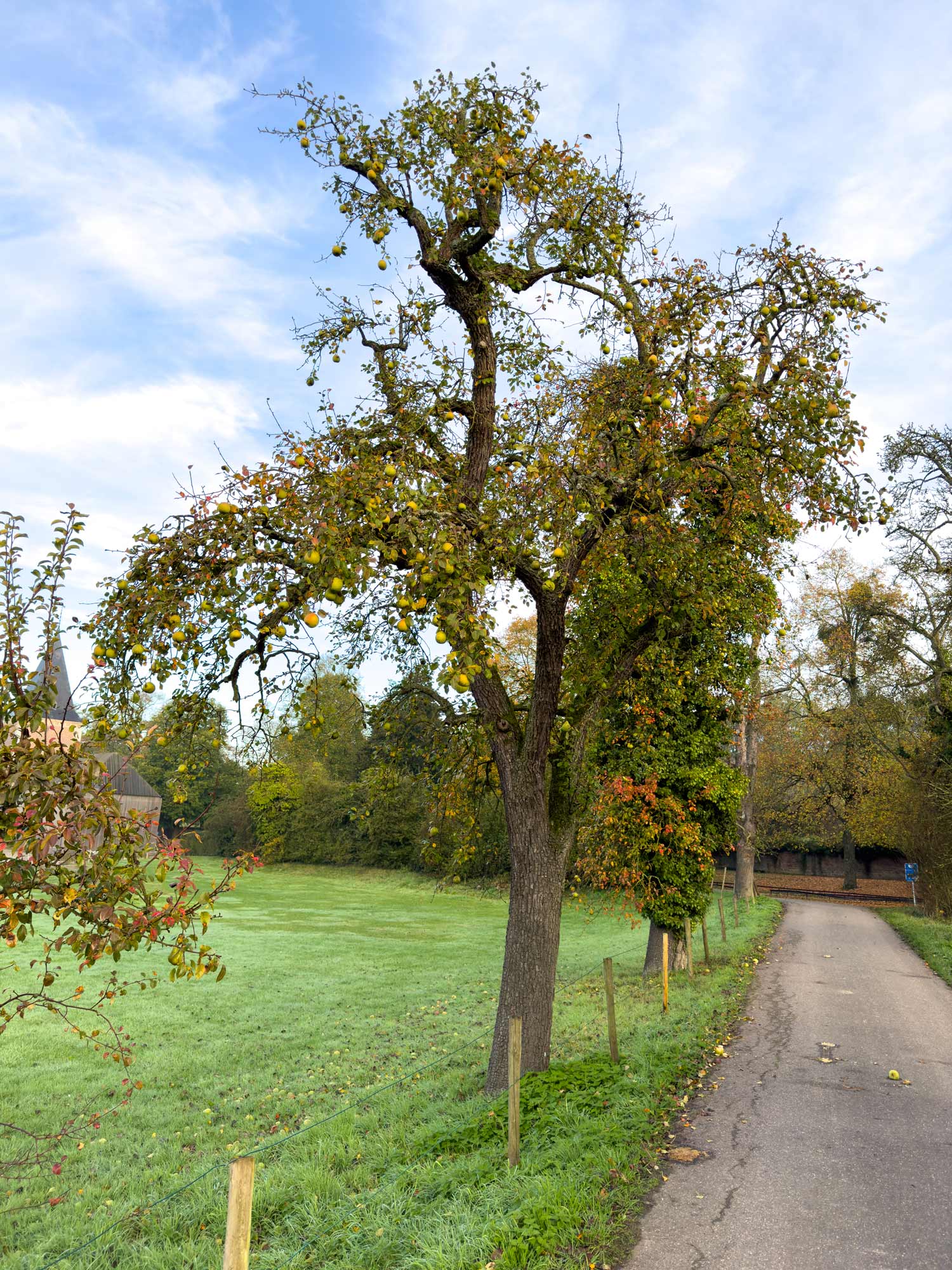
The Alden Biesen castle is surrounded by a hundred acres of orchards. As we were hosted onsite, we strolled across the estate outside exhibition hours. The orchards are managed with different goals, from fruit production to wildlife discovery. They have something in common: the conservation of five hundred heritage varieties of fruit.
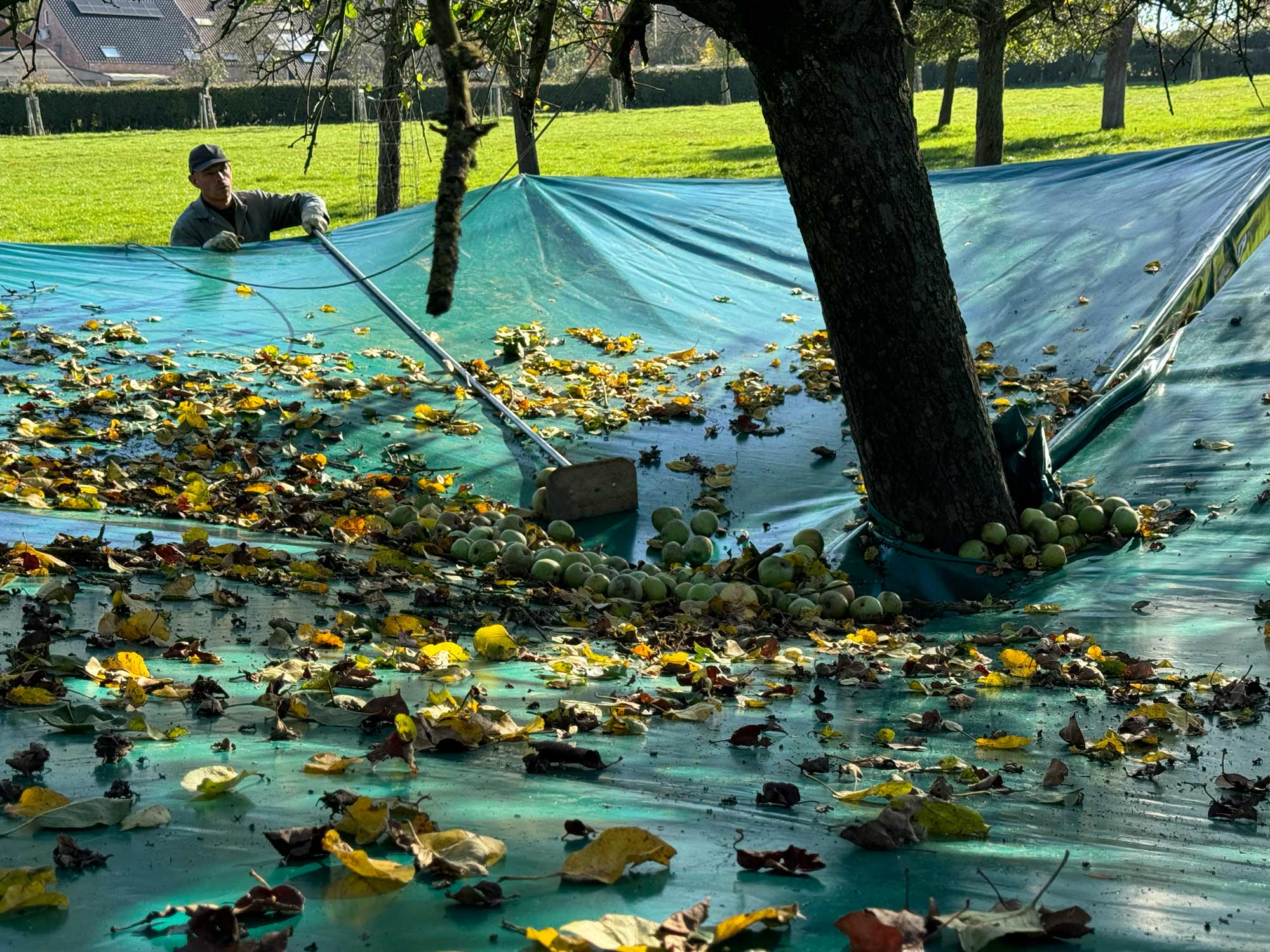
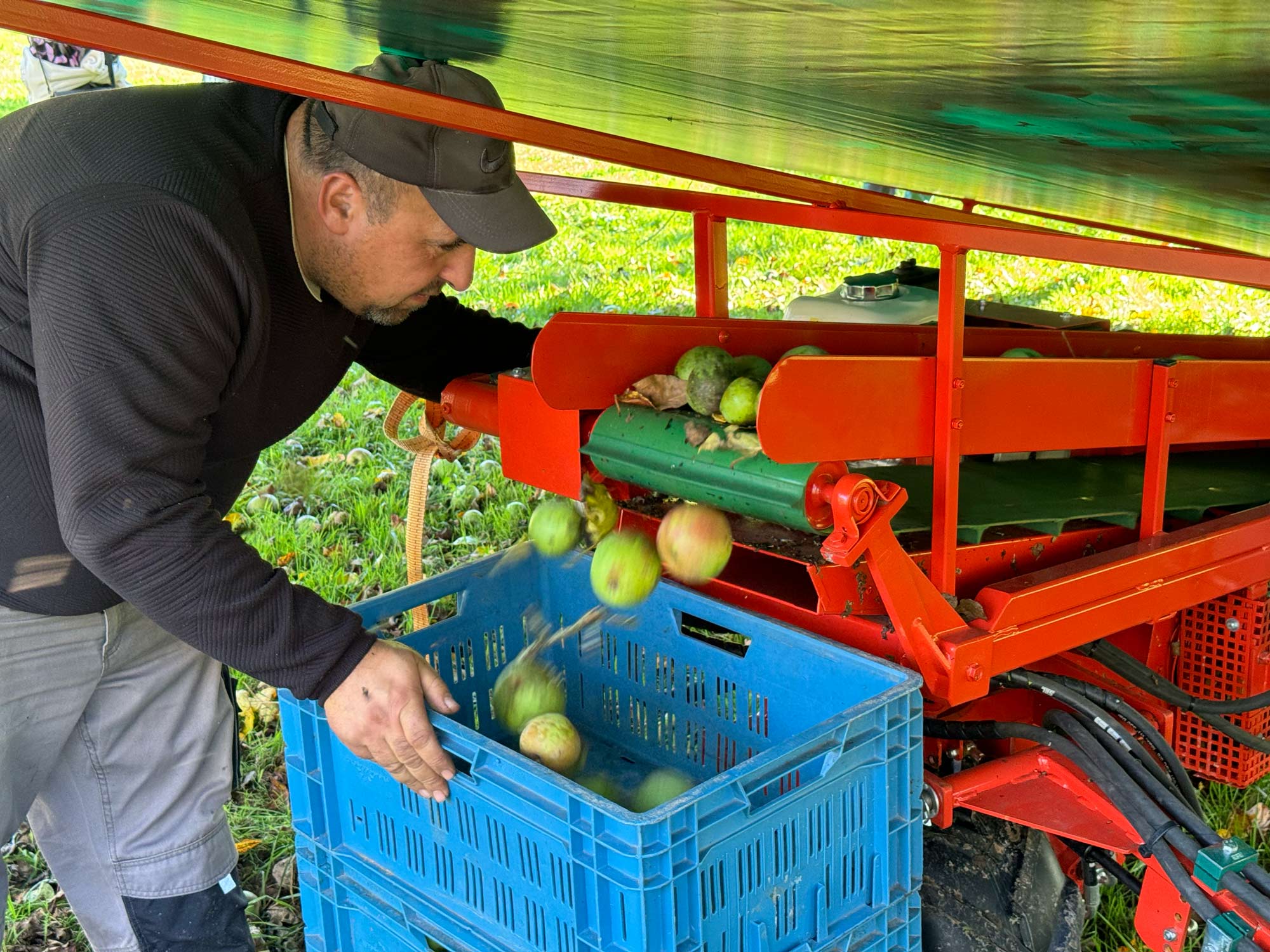
In one of the productive orchards, we were shown a harvesting system for large trees. It consisted of a mechanism to shake the tree activated by a tractor, connected to a large branch through a cable. The fruit fell in a tarpaulin unfolded around the trunk and were collected below it.
The exhibitors
- Belgium, Europom 2024’s host country
Fruit exhibition visitors in Belgium are guaranteed to see pears of all sorts. Whilst most of the fruit exhibited at Europom 2023 in France were apples, at Alden Biesen we saw a representative sample of the multitude of pear cultivars which grow in this country.
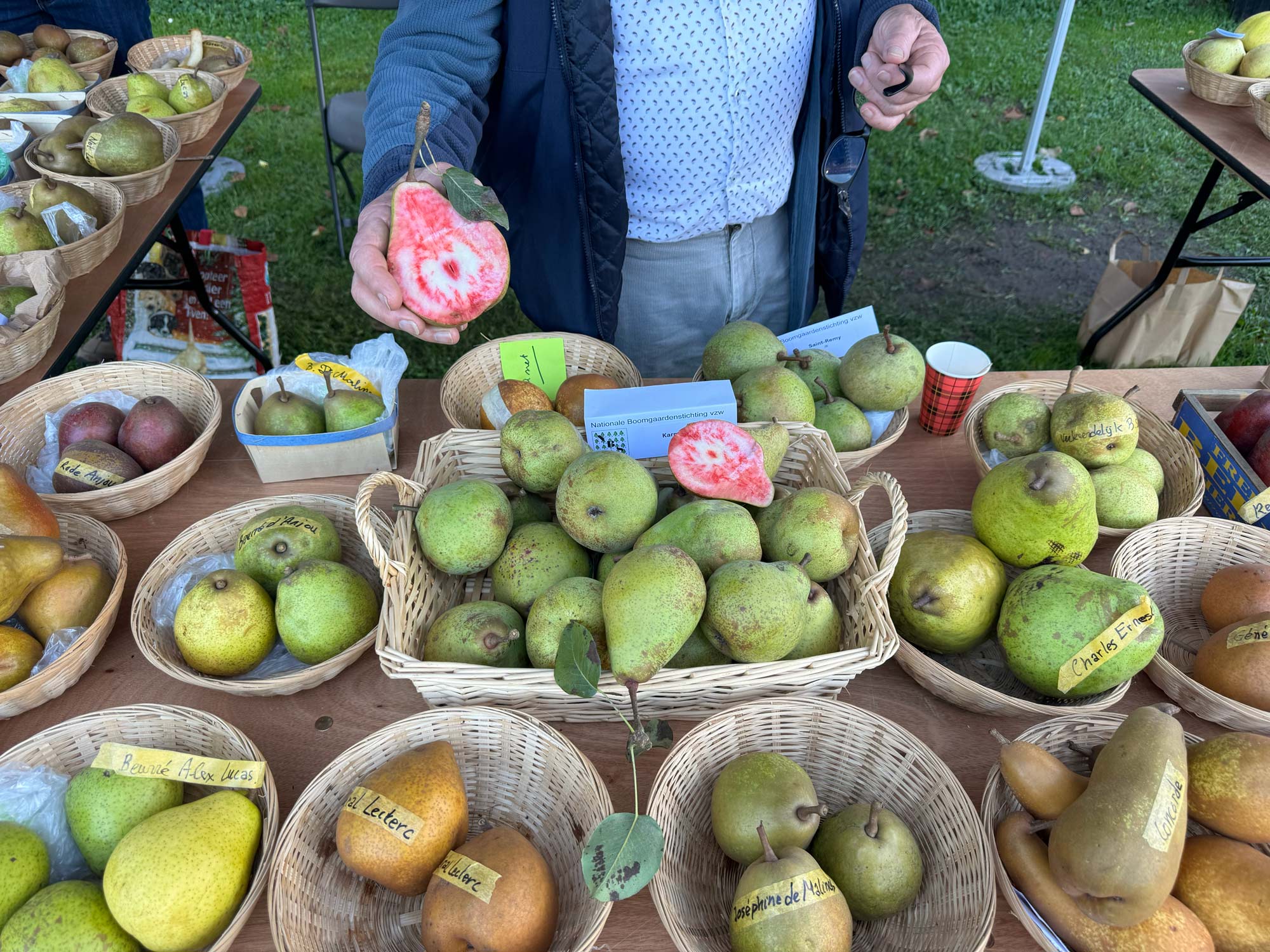
Belgium has a long breeding tradition, in particular of pear cultivars. The first significative outcome occurred in the middle of the 18thcentury with the creation of the Beurré d’Hardenpont (webpage in French), still found in nurseries today. ‘We hardly know that Belgium, in particular the province of Heynault, is globally renowned for being the craddle of the modern tender, sweet and juicy pear’, Diversifruits tells us on their website, also an exhibitor at Europom 2024 on the Wallonia’s stall.
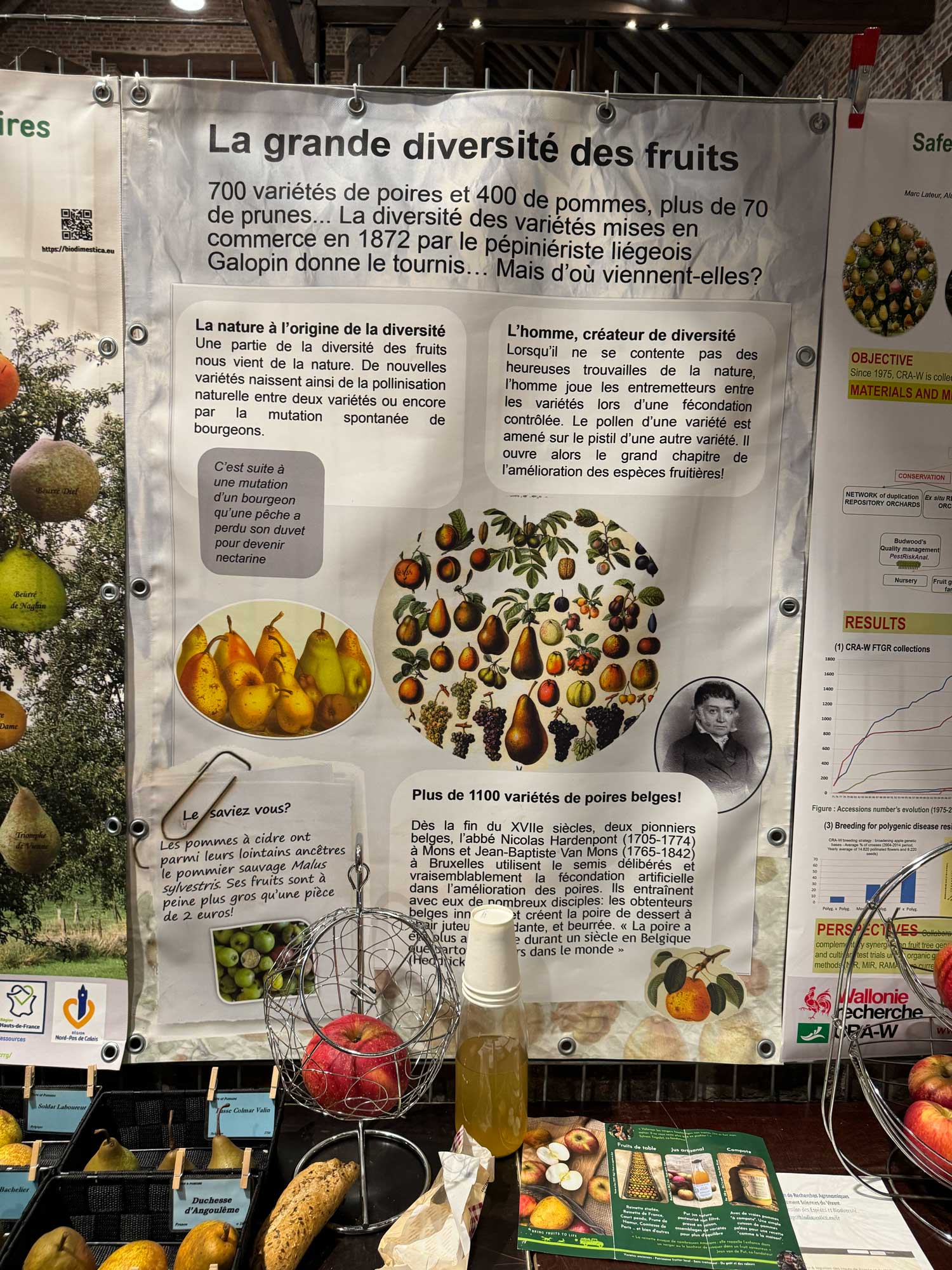
On this stall, visitors were made aware that if ‘diversity originates in nature’, humans are also ‘creators of diversity’. ‘When they don’t just rely on natural evolution and selection, humans intervene by carrying out controlled matchmaking’. This way, ‘more than a thousand Belgian pear cultivars were created’ (see poster below).
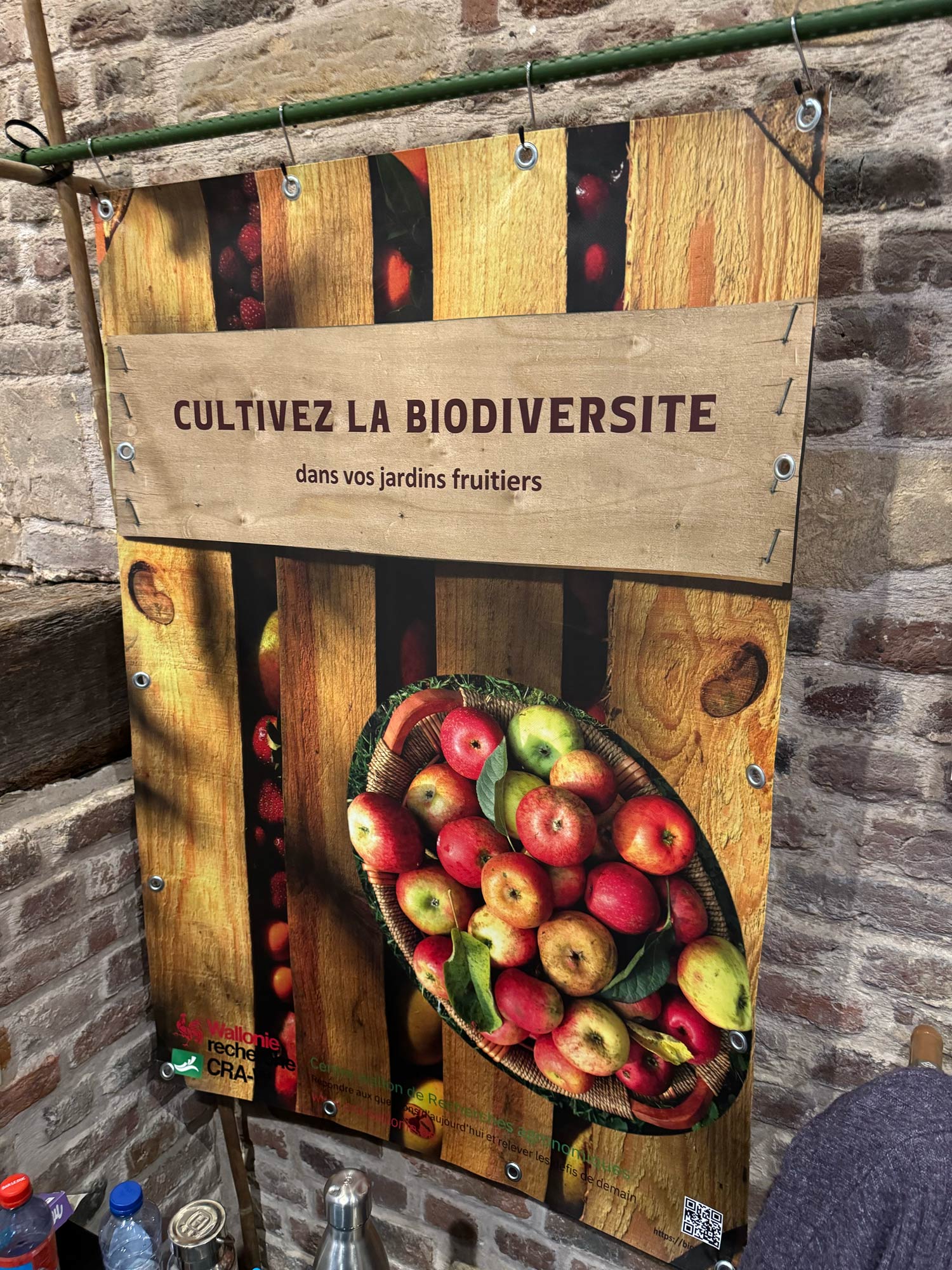
The country also pioneered biodiversity safeguarding, which was hit by the modernisation of agriculture. In a 2022 interview (in French) of the head of the Biodiversity department of the Walloon Agricultural Research Center (CRA-W) we learn that it began as early as the 70s. He explained how big a success the initiative has been, thanks to the “enthusiasm” of the Belgian people who contributed to “saving heritage varieties in all Wallonia”. In return, the CRA-W created partnerships with nurseries to give access to the most worthy cultivars for the quality of the fruit and their resistance to disease and pests. Garden owners can therefore plant local varieties to be grown without pesticides and fertilisers. We also learn that the cultivars are studied and crossbred to create new ones which require less treatments in commercial orchards and allow for organic production. The CRA-W collaborate with organisations from other countries and countries such as French Nord-Picardie, to share resources and best practices. Philosophie générale de la création du Réseau wallon des vergers conservatoires, a pdf document in French, allows to understand the full extent the CRA-W’s engagement in favour of biodiversity and the development of resilient ecosystems. They study ‘the sensitivity (of fruit cultivars) to disease in orchards which have been left untreated since 1979’. We therefore have forty five years of scientific research data on ecosystem management without chemicals here.
In 2023, Belgium became the largest pear producer in Europe. One single variety though, the Conference pear, made up 91% of the output (page 5), which is evidence that commercial growers don’t take advantage of the diversity of cultivars available in the country. Research findings on biodiversity and ecosystem management, which provide guidance for more resilience and adaptation to climate change have not been applied by the agriculture sector yet. The simplest example that comes to my mind is that the risk of losing production due to unexpected heavy downpours or late frost during the blossoming of the Conference pear could be mitigated by planting several varieties on the same farm which blossom at different times.

The stall of the Limburg province of Netherlands also displayed samples of these varieties.
- Other exhibitors
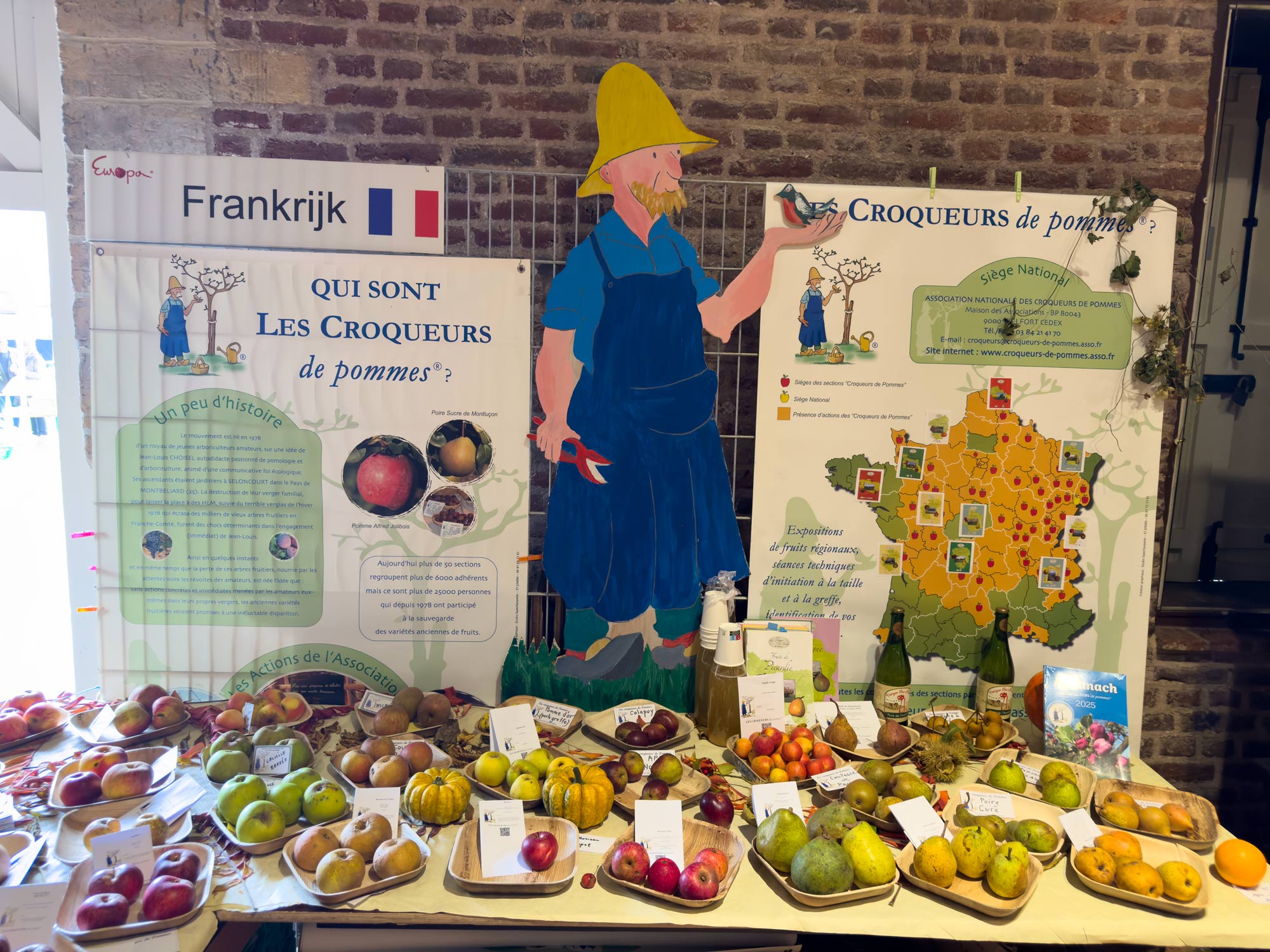
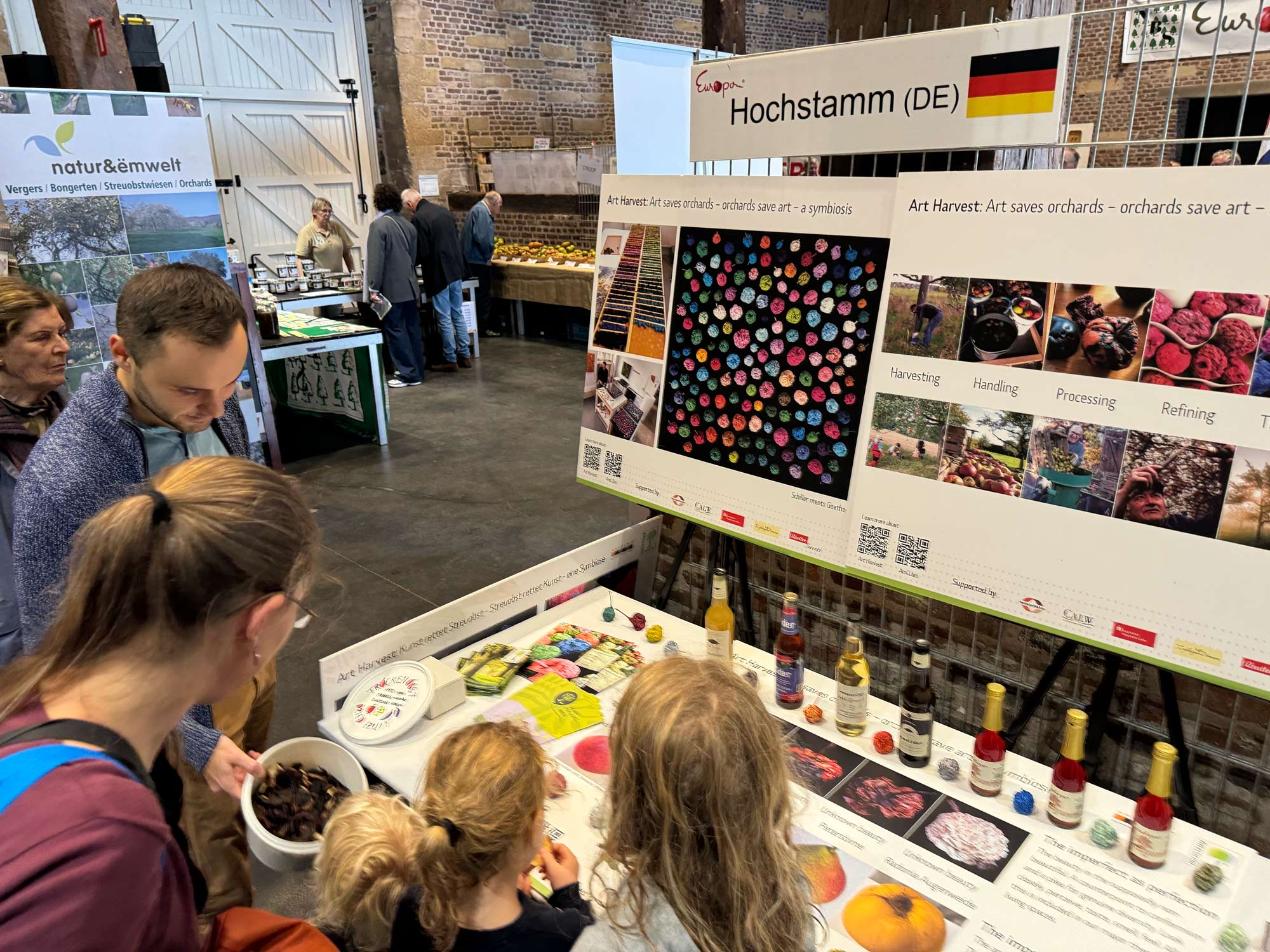
Austria, Belgium, the Czech Republic, France, Germany, Holland, Luxembourg, Sweden and the United Kingdom are regular participants to Europom, recently joined by Hungary. Other countries and organisations occasionally join the event, like Poland and Slovakia which attended Europom 2017.
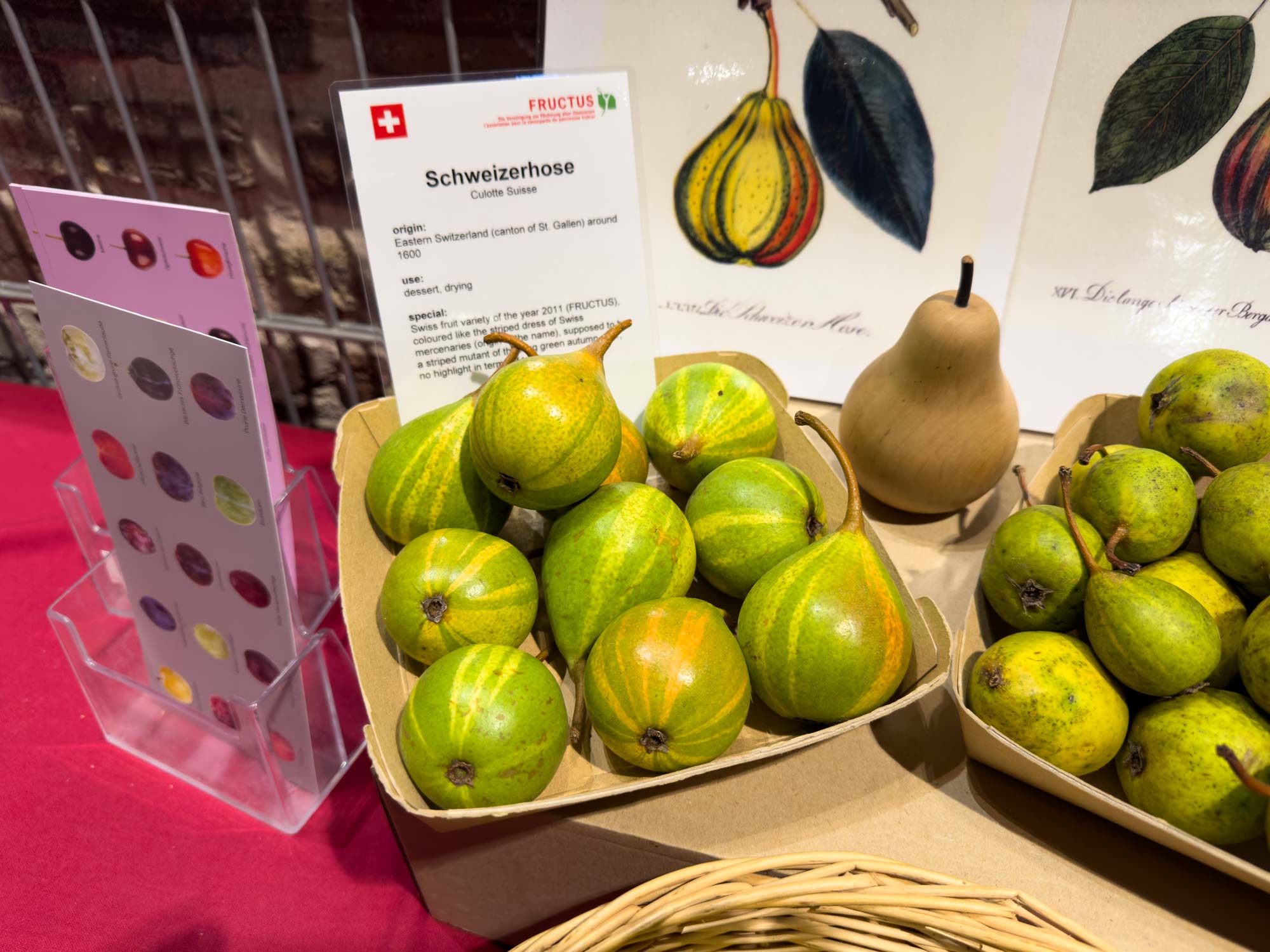
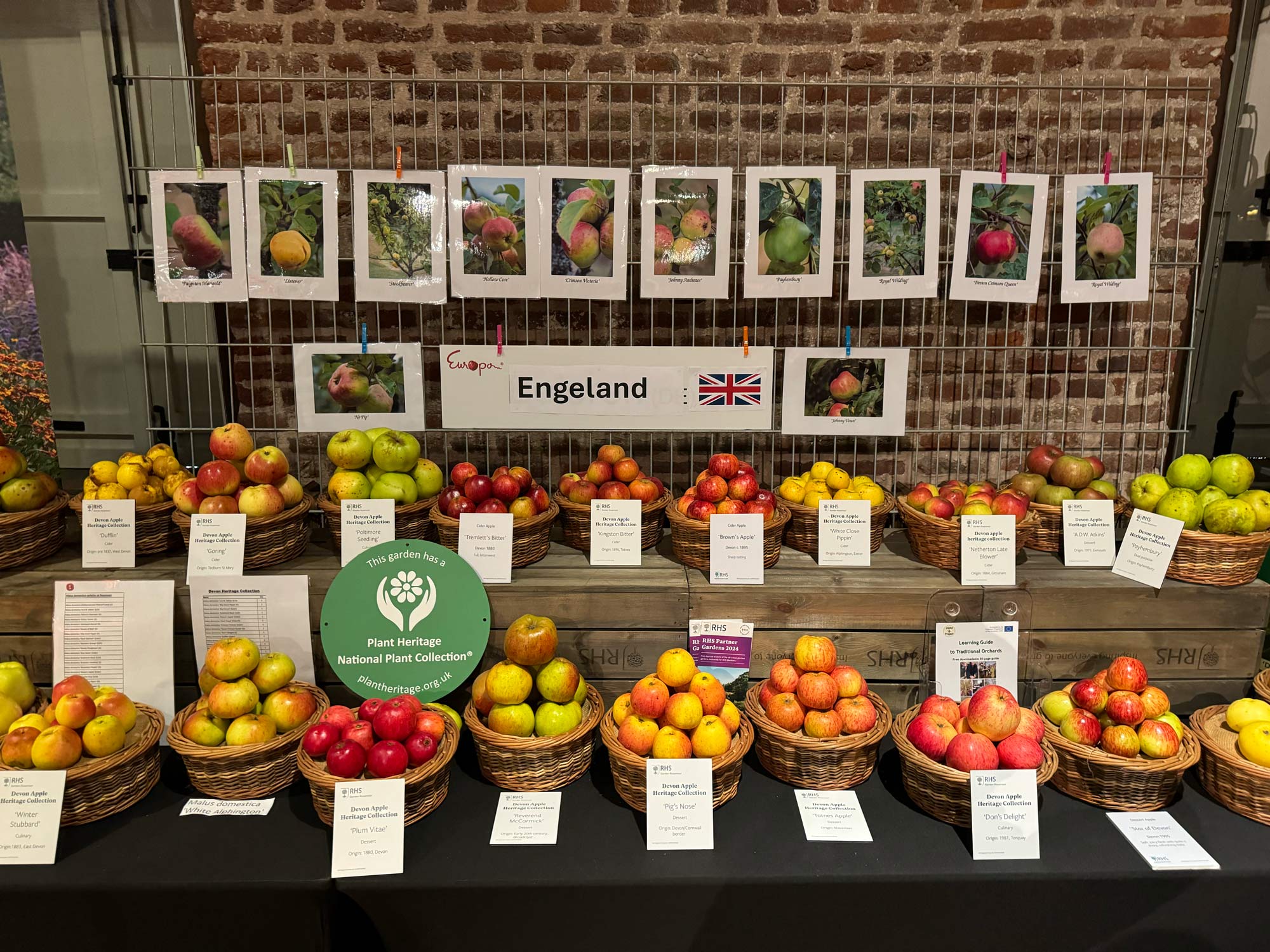
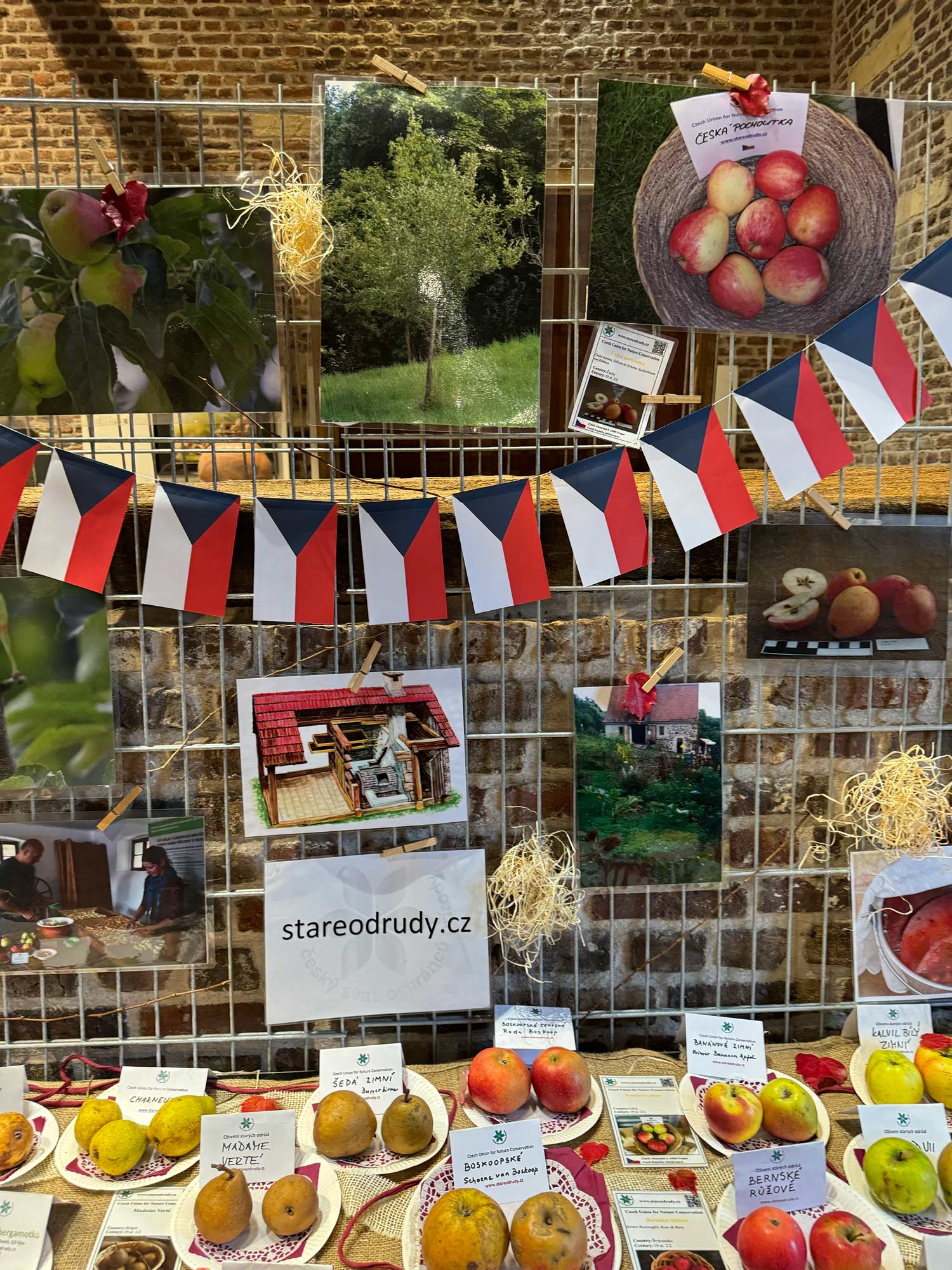
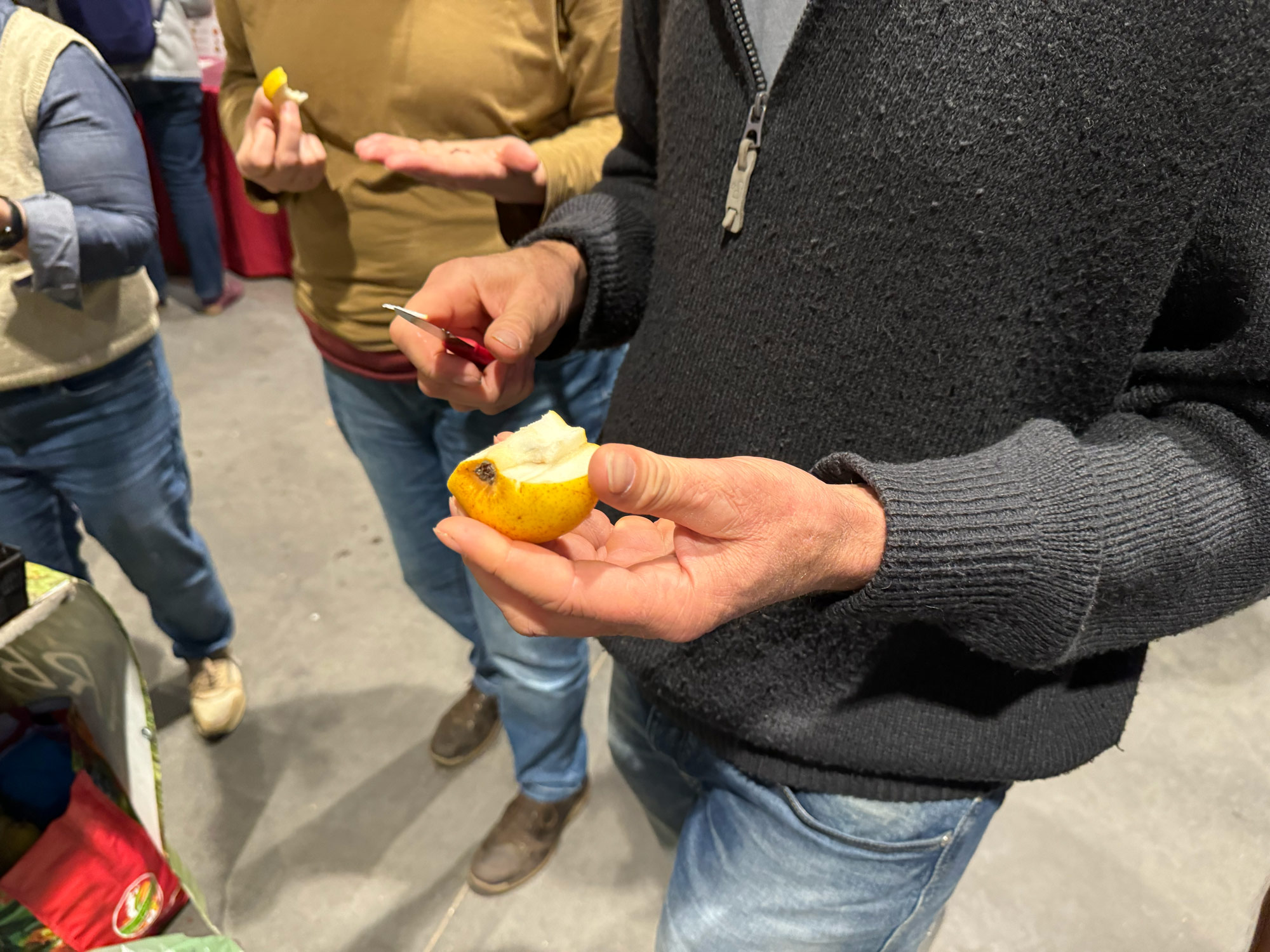

To summarise what I learnt from Europom 2024 and the additional research I carried out to write this article, I will say that the experience more than lived up to my expectations. I was really keen to go to Belgium as I knew the country was playing an important role in the safeguarding and promotion of European fruit heritage, I now realise to what extent it is true.
COP 16
Whilst Europom 2024 proved a success in my view, the 2024 United Nations Biodiversity Conference which took place in Columbia from 21 October to 1 November 2024 unfortunately didn’t live up to expectations. But it is the vocabulary used in its conclusion statement to qualify the relationship between humans and nature that attracted most of my attention:
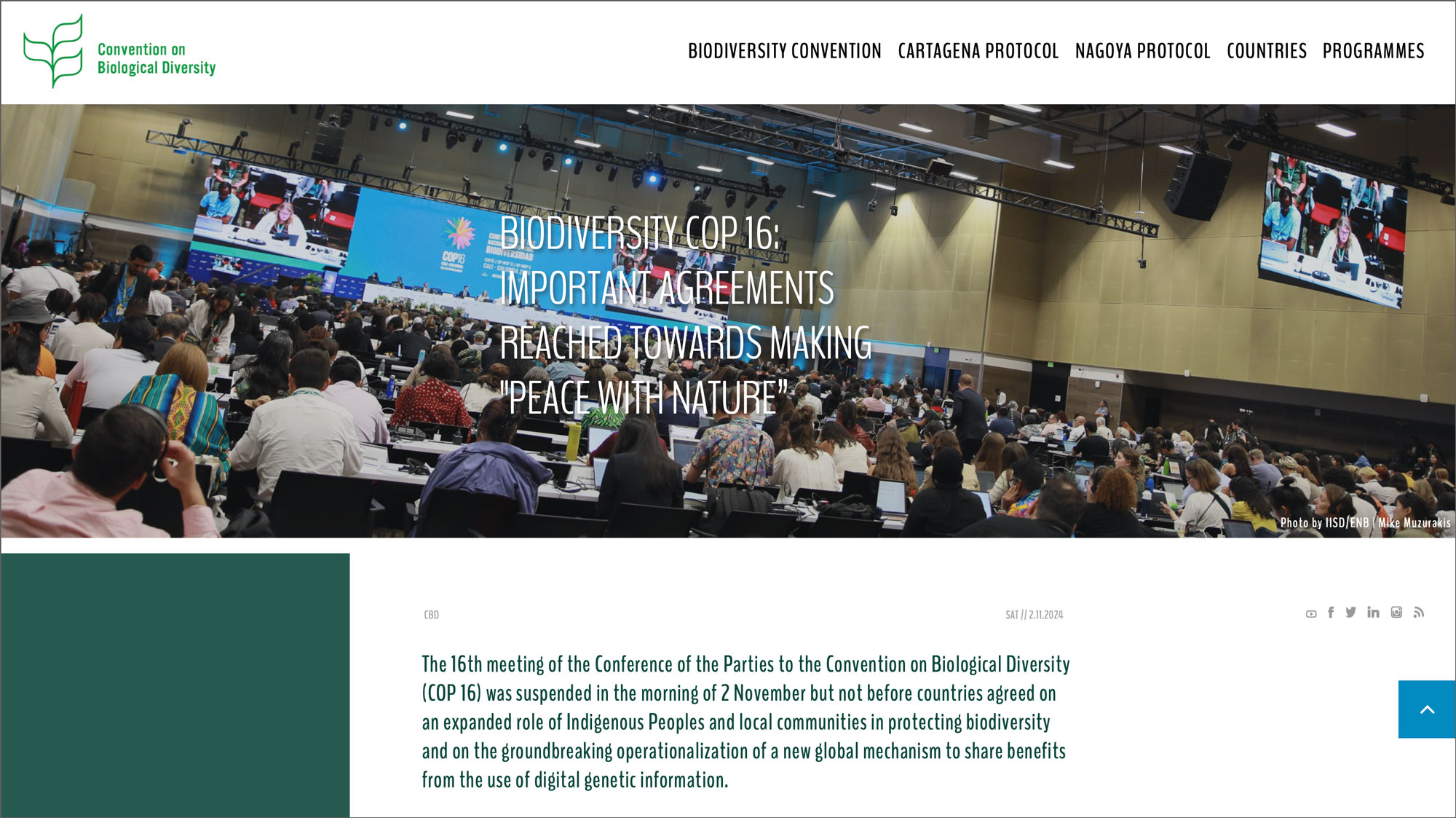
‘Biodiversity COP 16: important agreements reached towards making “peace with nature”’. These words puzzled me. Are we at war with nature? It is certainly not the case of the organisations present at Europom 2024, which relentlessly work with nature rather than against it.
I found out where these words came from. They were part of a speech by the Secretary-General of the United Nations given on 2 December 2020. “Making peace with nature is the defining task of the 21stcentury. It must be the top, top priority for everyone, everywhere”, Antonio Guterres said. The COP Biodiversity roadmap is built on this premise.
The problem with this vocabulary is that it perpetuates a simplistic divide between humanity and nature, which we should get away from, anthroplogists such as Philippe Descola say. When are we going to ‘entirely rethink political action and living together in a world where nature and society are no longer irremediably divided’?
Where are we after “The State of the Planet” address by Antonio Guterres at Columbia University in 2020? We all can see that in 2025 “the old normal of inequality, injustice and heedless dominion over the Earth” which he said “we cannot go back to” is coming back anyway. It makes me feel like putting even more work into cultivating our gardens. Anyone interested in our relatively small but long-standing movement is welcome to join.
 Les Jardins d'ici