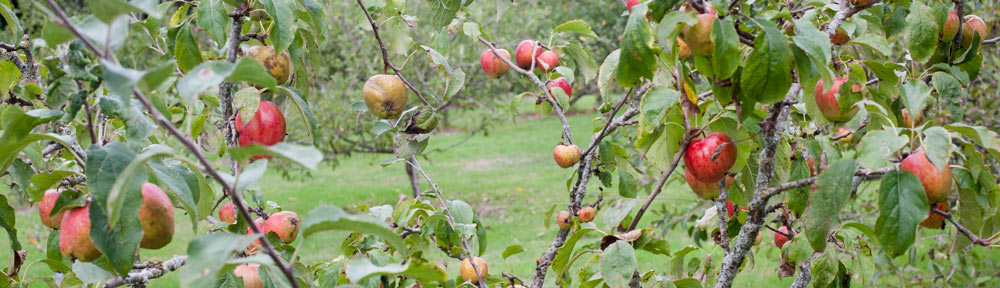

The book Des murs vivants (Living Walls) made me realise how the wall of my garden was even more of a haven for life than I’d thought.
I published the French version of this article on the 10th of June 2024 for a reason. Two years earlier, on 10 of June 2022, I’d written to my neighbour, a public institution: “… I therefore wish to discuss our projects and possible adaptations…”. The day before, I’d discovered their intention to coat the wall which overlooks my garden with reinforced concrete. They never expressed any willingness to change course. The wall is now dead.
The destruction came at a personal cost. I consider the disrespect I have been subjected to and the violation of my property rights as serious offences which I condemn in the strongest terms. But the destruction also deprived our common heritage of a precious asset. My article focuses on this second element.
Living Walls (Des murs vivants) is a book published in Switzerland in 2022 with the support of the canton de Genève. It helps us to understand the value of a wall as a host to plants, animals and other living beings. We will assess how interesting the wall of my garden was for biodiversity in the light of the book’s evaluation grid.
The book also provides practical guidance on how to maintain existing walls and build new ones with a view to fostering biodiversity. I hope the example of my garden, coupled with this guidance, will raise awareness of what should and shouldn’t be done, as well as changing attitudes in our public institutions.
Des murs vivants (Living Walls) – The book
As a child playing in the garden of our family home in the heart of the Massif Central, I knew its old stone walls were full of life. As an adult amateur gardener who likes old stones, I removed excess ivy on the tall wall at the back of the garden in 2013. As an expert on kitchen garden history who studied this piece of architecture, built centuries ago to optimise food production, I observed its fauna and flora, the lizards and birds who had made it their home.
The book Des murs vivants (Burgisser, 2022) reinforced my belief that conserving this heritage wall as part of my plan to renovate my kitchen garden, would both meet my personal aims, and have a wider impact, addressing the broader need to protect life for the common good.


“Demolitions, inappropriate renovations and “cleansings” wipe out a wall’s ecosystem”. This sentence is highlighted in the book introduction. The Swiss public authorities convey a clear message: “the canton de Genève intends to promote developments in support of biodiversity. This book maps various types of walls, how interesting they are for fauna and flora, and advises on how to maintain, repair, build walls with a view to fostering biodiversity. It is therefore aimed at all the professionals who deal with walls (masons, architects, public services, etc.) and ordinary citizens who own a wall or wish to build one.”
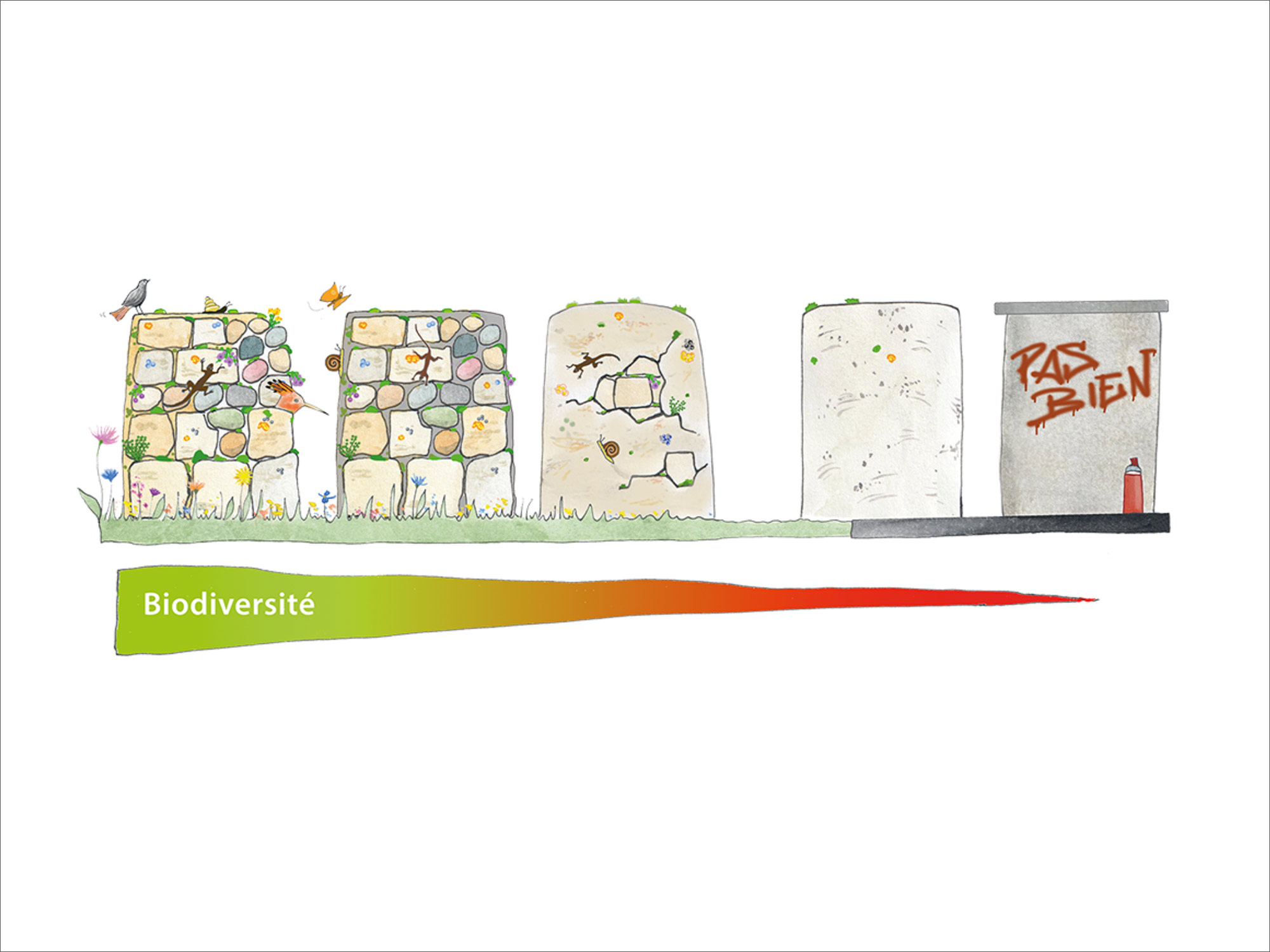
I was given permission to reproduce the following drawing, which in my view aptly conveys the main message of my article and the book: concrete is not good for biodiversity, so when we can, we should avoid using it!
The wall of my garden
Reading Hélène Burgisser’s book made me realise that the wall at the back of my garden, around one hundred metres square, was even more interesting than I thought in terms of its biodiversity. Made of exposed stones grouted with mortar, it topped the rankings, as we can see in the figure below:
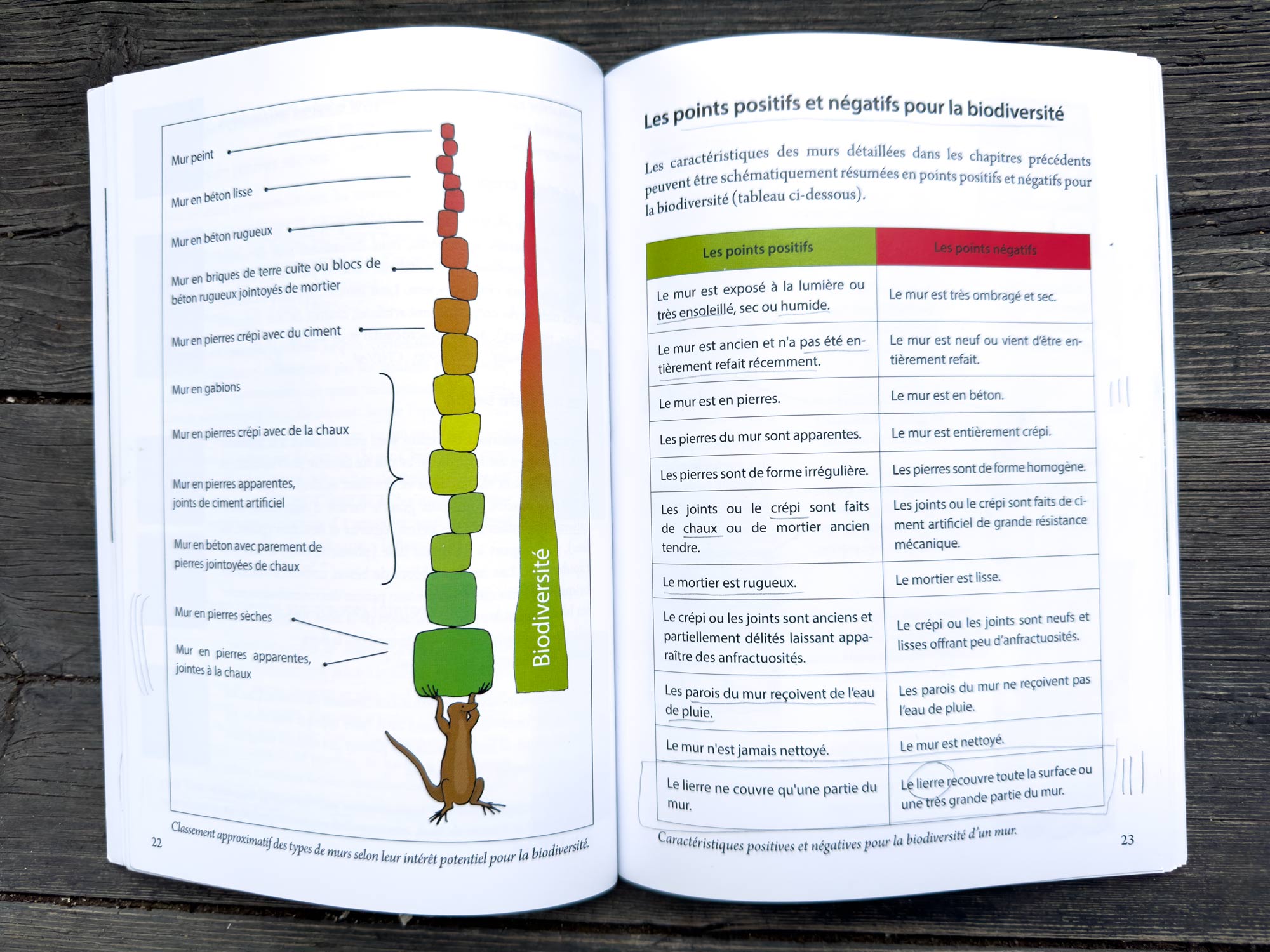
The author speaks of an “approximate ranking”. Other positives and negatives should be taken into account to allow for a more precise measurement. The main positive and negative points are listed on page 23 above.
The wall of my garden achieved top ranking not only because it was made of exposed stones grouted with lime mortar or another kind of ancient soft mortar, but also because it scored highly on other positive points, in particular those at the top of the list.
Positive point N°1: “The wall is exposed to light or very sunlit, dry or moist.” The wall of my garden faces South / South East, and is not overlooked. Moreover, it sits against a mound. The designed crevices (weep holes and bottom of the wall made of large stones) or those which appeared as the wall was aging, coupled with the mortar’s “permeability” to moisture (page 24), helped regulate its temperature and humidity. These crevices provided cool shelter for the flora and fauna which inhabited the wall or grew against it, like espaliered fruit trees, limiting the impact of heat waves and droughts. The wall also allowed for animals, plants and other living beings to benefit from light and sun throughout the year. At night, the dark stones’ radiation of heat stored during the day prevented the late spring frost from damaging the fruit trees’ blossom and so avoided the subsequent loss of fruit crops. The same dark stones and plants growing on them protected the fruit from burning due to reverberation of sunlight in the summer. I would like to stress that the wall was purposely built for agriculture before the 1789 French Revolution. It was therefore designed to that end and probably improved over time.
Positive point N°2: “The wall is old and has not been fully renovated recently.” The first three meters of the wall of my garden were multi-centennial and had not been touched for at least fifty years. Its base, made of large basaltic stones, might have never been disturbed at all.
“The walls made of exposed stones grouted with mortar reach record levels of biodiversity over time thanks to the diversity of habitats this offers: stones, mortars, and later on crevices.” (page 20). Unfortunately, the wall was entirely smothered in concrete in 2022. Now that “The wall is made of concrete”, its interest in terms of biodiversity is measured… in negative points!
I won’t analyse further what made the wall of my garden interesting for biodiversity and what doesn’t anymore, because it breaks my heart. For instance, I won’t detail what I found in one of the ancient weep holes before it was destroyed. Among other things, there were snail shells. Maybe another time. But why was the wall covered in concrete?
A wall must be solid, especially if it supports land, as is the case in my garden. Yet, the canton de Genève says: “Walls must be maintained and punctual repairs are sometimes inevitable, nevertheless it can be done taking into account the living beings which inhabit them.” (page 3). I also acknowledge that “the solidity of concrete can be required in certain situations.” (page 25). That was my neighbour’s view. However, the wall overlooking my property was far from the buildings around it, and at least the first three metres showed no sign of deformation. Another kind of renovation could have been considered here, especially as I was keen to contribute to it financially. Concrete can be remarkably effective, but we should avoid using this material in a garden, all the more if the garden is listed!
Biodiversity in my garden today
Here are two examples of the direct impact of this concrete on biodiversity in my garden. Some of the plants and animals are still there, however they are now confined to a much smaller space. I am using a page of the Living Walls book to introduce each example, followed by pictures of my garden before and after the intervention of my neighbour.


Left, the big wall today. 11th April 2024.
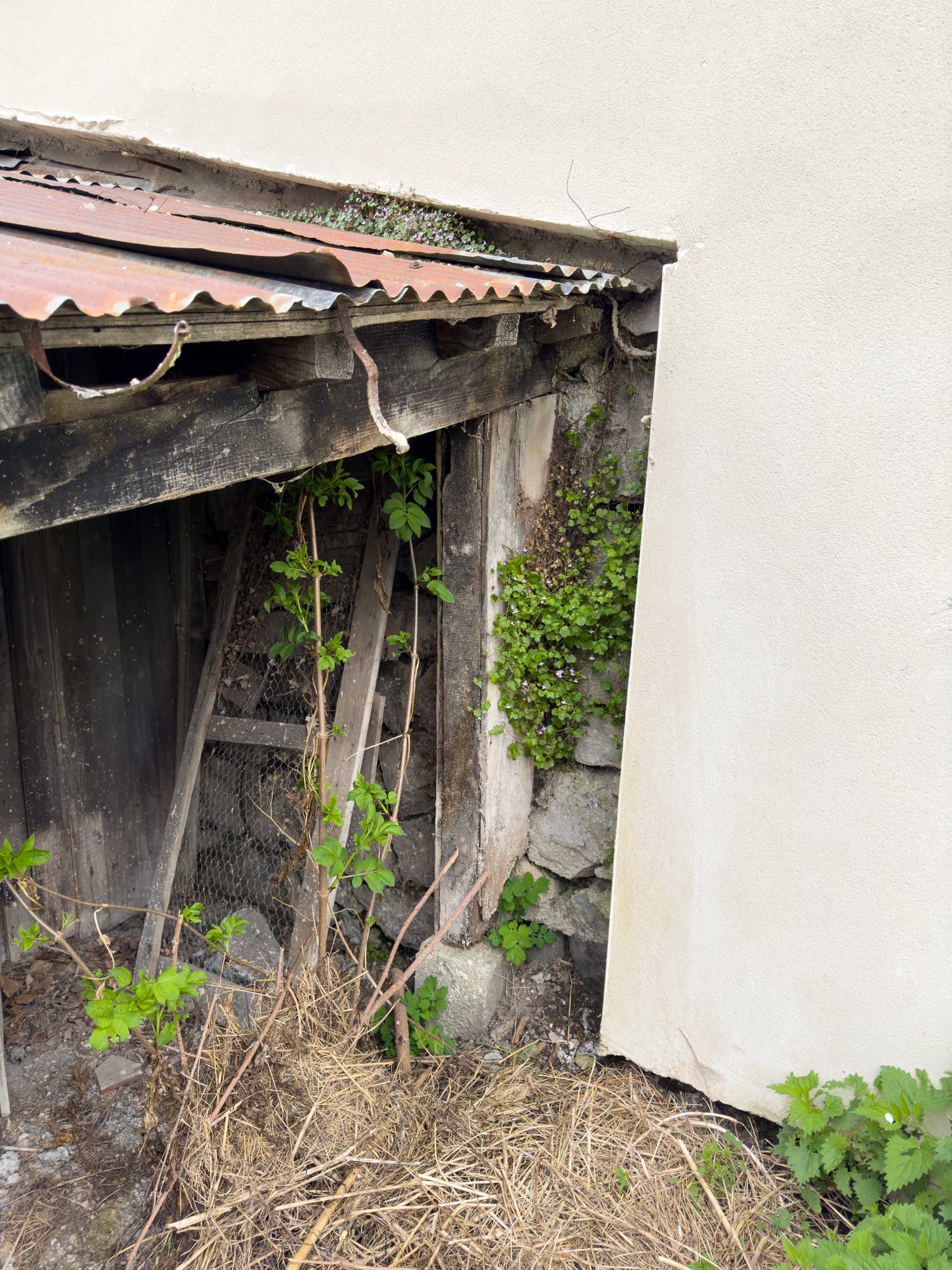
Coating the wall with reinforced concrete did not only destroy the ecosystem of the wall. “This ecosystem is part of a broader environment to which it contributes in various ways. The demise of a wall therefore has consequences far beyond its small universe.” (page 4). Beyond the loss of habitat, water and food for the plant and animal species which lived there or visited, the vast amount of concrete used will probably also disturb the centuries long ecosystemic balance of the garden.
Aware as we are today of the carbon footprint of concrete and the worrying levels of biodiversity loss, how can we continue to allow such projects to be designed and implemented? How can we refuse to consider other solutions when they are possible and sought by those who will be most affected? In the light of Helene Burgisser’s wonderful work on living walls, these questions need to be seriously considered.
References
Burgisser, H. (2022), Des murs vivants, Genève : Éditions Rossolis
https://boutique.rossolis.ch/fr/nature/3319-des-murs-vivants.html
(in French, accessed 20th June 2024)
Citations translated from French to English by the blog post’s authors.
Map of the Massif Central:
https://commons.wikimedia.org/wiki/File:France_Massif_central.jpg (accessed 20thJune 2024)
 Les Jardins d'ici
I don’t know how many lizards can live in a biodiverse wall like mine was. If we say one per square meter, which doesn’t sound unreasonable to me given the amount of shelters they could live in, that makes around a hundred. They were of the white morph of the common lizard (looking at the pictures in the article below). Some males displayed a few small light blue spots around the front legs / behind the ears. If I remember well, it is also on this wall that I spotted a few specimens which at some periods of the year displayed some rather discrete orange on the flanks. I am not sure they were male or female.
The renovation of the wall could have been designed to maintain shelters for the lizards, for instance leaving a few interstices unfilled with mortar. It could have become a place for biodiversity observation, in an environment which had hardly changed for more than two centuries. But now the wall has been concreted, it is quite a different story. To start with, it is a cemetery of perfectly healthy specimens which died suffocated, if not drowned in concrete, when the bullies intervened week commencing 24 October 2022.
If I write about this today, it is because I have just read this Guardian article on the diversity of wall lizards in Italy: https://www.theguardian.com/environment/2026/feb/28/conservation-biodiversity-species-genetics-wall-lizards-aeolian-italy-aoe?CMP=GTUK_email